

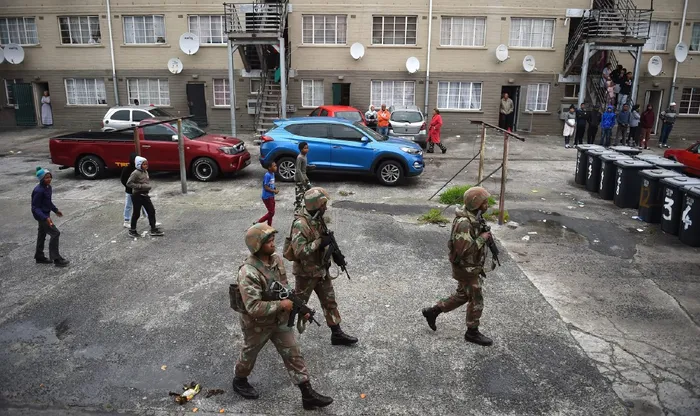
The South African National Defence Force (SANDF) is set to be deployed to combat rising gang violence, sparking debate among civic organisations and government officials.
Image: FILE
Once their training is complete, the South African National Defence Force (SANDF) will be deployed to hotspot areas until March 31 next year.
Acting Minister of Police, Firoz Cachalia, on Wednesday conceded that the deployment of the SANDF will not be a magic bullet solution to crime plaguing parts of the country.
Cachalia, alongside the National Police Commissioner, General Fannie Masemola, addressed a joint meeting between the Portfolio Committee on Police and the Portfolio Committee on Mineral and Petroleum Resources, on the deployment of the SANDF in support of SAPS operations.
The committees heard that the deployment of the SANDF is authorised under Section 201(2)(a) of the Constitution of the Republic of South Africa, 1996, and Section 19(3)(c)(ii) of the Defence Act, Act 42 of 2002.
Masemola said that the SANDF will be deployed to hotspots identified in the Western Cape, Eastern Cape, Gauteng, North West, and Free State.
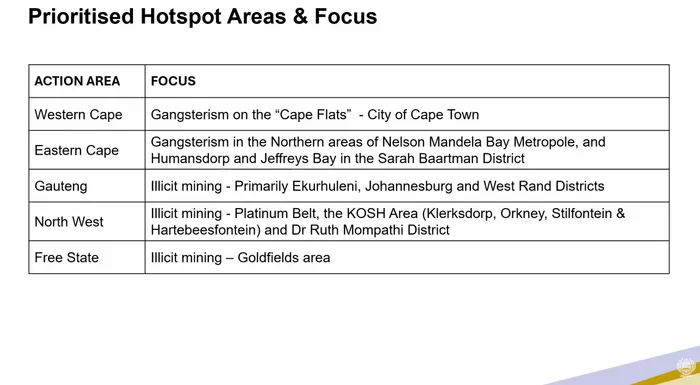
The hotspots where the SANDF is expected to be deployed
Image: Screenshot
The committee heard that each entity shall retain its distinct command authority throughout the operation, and that operational coordination shall take place through Joint Operational and Intelligence Structures (JOINTS) at national, provincial, and local levels.
The operation shall be coordinated with both designated SAPS and SANDF commanders to ensure unity of effort. Based on joint command training for alignment, coordination and synergised operations.
Monitoring and evaluation will occur and be reported through Project Management processes under the auspices of the overarching National Organised Crime Combatting Operation (“Ukubuza”).
Masemola explained that deployment will commence on March 1 2026 and conclude on March 31, 2027, but he said that while training is underway, the rollout of the SANDF will only be determined once they have completed training and have been deemed ready for deployment.
He indicated that they will likely go full speed from April onwards.
While Finance Minister Enoch Godongwana had explained that the current cost of the SANDF deployment is unknown, he deduced that they would be funded through Section 16 of the Public Finance Management Act (PFMA), which governs the use of funds in emergency situations.
Masemola gave more insight, explaining that while they will still have to brief the committee on how funding will work, the current funds being used by SAPS will come out of the R1 billion assigned to combat organised crime. He said the SANDF has their own budget that will support the deployments.
“The deployment of the SANDF is there to stabilise the areas, while the rest of the (SAPS) teams will be dealing with the organised crime, with a view to dismantling those organised crime syndicates. That is the main objective that stabilisation happens within the gang and illicit mining areas, while organised crime teams deal with all the gangs and all other forms of organised crime,” Masemola said.
“It will not be a member from a police station who is drawn to go and work with the SANDF, because that would create more shortages at the police station. Mostly, you have specialised units that work with the SANDF, like the NIU Special Task Force.”
When asked about who would be in control on the ground, the committee heard that SAPS will be the authority on the scene, and SANDF is there to support and stabilise SAPS’ efforts.
Cachalia said: “The deployment of the SANDF is not being presented as a panacea, (or) as a magic bullet. As the national commissioner said, the deployment of the army is a stabilisation strategy to create space for the implementation of an organised crime strategy that was adopted by the Cabinet about a month ago.
“It's in the process of being implemented,” Cachalia said.
He also added that they have taken previous SANDF-SAPS deployment experiences into account to learn from them and mitigate any risks that could arise.
“Really, what we are looking for with this deployment of the military is to augment the primary role of the police - the frontline role of the police with additional strategic capabilities which the army does have. It is not so much just as a boots-on-the-ground approach by flooding communities with soldiers and so forth, because those will increase the risks of unintended consequences,” Cachalia said.
Cape Times