

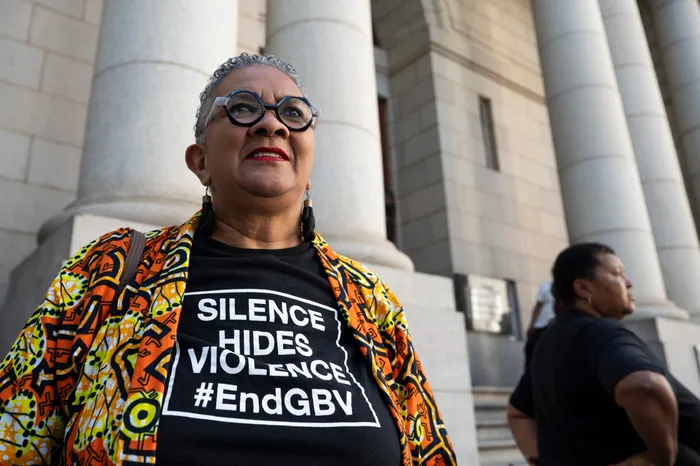
African Feminist and Human Rights Defender, founder and ED of Callas Foundation, Caroline Peters, standing in front of the Western Cape High Court.
Image: Armand Hough / Independent Newspapers
The Western Cape High Court has questioned the purpose in naming a rape accused before he has pleaded “if the only purpose (in naming him) would be to shame him”.
The matter - in which anti-gender based violence activist Caroline Peters is taking on the Minister of Justice and Constitutional Development - is asking the Court to declare unconstitutional a law that “criminalises women and survivors for naming men accused of rape before they plead in court”.
The matter, which was heard on Tuesday and is set to continue Wednesday, is being heard before Judges Andre le Grange, Masoodah Pangarker and Acting Judge Pinda Njokweni at the high court.
Judge Le Grange said that perpetrators before court are considered innocent until proven guilty, echoed by Njokweni who said there are sections which protect the victim and sections which protect a perpetrator, with the court emphasising that each had the right to a fair trial.
Counsel for Peters at Women’s Legal Centre (WLC), advocate Ashleigh Christians, argued that two sections in the Criminal Procedure Act (CPA) should be challenged for its constitutionality which “still criminalises women and survivors for naming men accused of rape before they plead in court”.
The challenge was in terms of s 154(2)(b), which concerns the prohibition against the publication of any information relating to a charge involving a sexual offence (or extortion) before the accused has pleaded; and the second is s 335A, which concerns the prohibition against publication of the identity of persons towards or in connection with whom a sexual offence has been committed.
WLC argues that contradictions in the sections of the CPA have real consequences in a country where sexual violence disproportionately affects women and that it violates women’s rights to equality and freedom of expression, silences survivors, and undermines the investigation and prosecution of sexual offences in South Africa.
WLC submitted that unlike a murder or any other serious crime, once a charge has been lodged against an accused rapist, it is illegal to name him, or mention any identifying details, until he enters a plea of guilty or not guilty in court.
During arguments placed before court by advocate Christians, Judge Pangarker put a hypothetical scenario in which the investigation is concluded and the State said they “don’t have a hope in hell” of securing a conviction, where charges could be withdrawn against a rape accused before having made it to the plea stage. Acting judge Njokweni said in instances as that, and where false accusations are made, the alleged perpetrator “walks away with their dignity”.
Advocate Christians said: “My interpretation of the Act is that the charge is only properly so called when the prosecutor makes the decision to put charges against the accused. That could mean in court, or by summons. My interpretation of it may well be incorrect of how the sections work together.”
In her heads of argument, Peters “persists with her contention that s 154(2)(b) unjustifiably prohibits the publication of an accused’s identity before he has pleaded”.
“To the extent that it does so, the purpose is to protect the accused and not the complainant. Thus, the section is inconsistent with the Constitution on this basis, too.
“The Minister opposes this part of the applicant’s challenge and contends that s 154(2)(b) is not aimed at protecting the identity of an accused charged with having committed a sexual offence. The Minister contends that the section serves two purposes: (a) it creates a holding position until such time that a court may make an order in terms of section 153(3) of the CPA; and (b) it serves to protect the identity of complainants in relation to the offences listed in section 153(3).”
Cape Times