
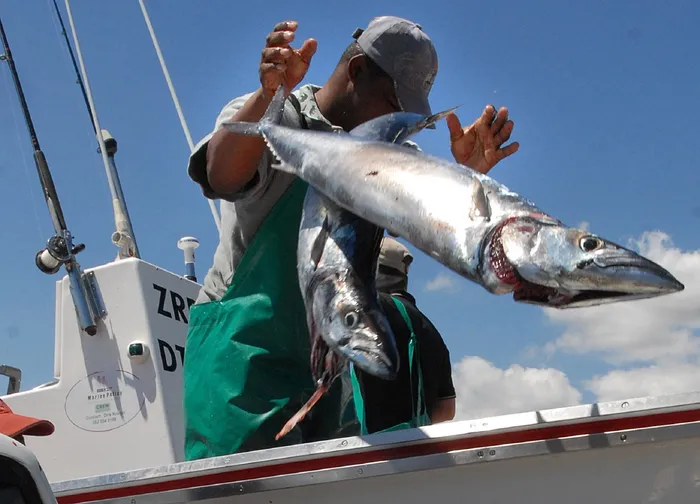
Cape snoek is one of South Africa’s most important fish species
Image: FILE
Cape snoek continues to be a staple for many people, especially those in low-income households, as well as a lifeline for small-scale fishing communities.
But after years of stable catches, snoek is now more vulnerable than it appears. Declining catches have put pressure on local fishers and opened the door to imports from New Zealand. This has raised concerns about the future of local fisheries and the survival of coastal livelihoods that depend on them.
A new study by Dr Sihle Mthethwa from the Department of Genetics at Stellenbosch University (SU) highlights the vulnerability of Cape snoek. By analysing the fish’s genetic makeup, Mthethwa, who received his doctorate in genetics at SU recently, found that snoek populations are split into distinct groups that do not mix freely, both globally and along South Africa’s coastline.
“This challenges the idea that Cape snoek is a single, resilient resource. Instead, it emphasises the need for careful, locally tailored management to protect this iconic fish – and the communities that depend on it – for the future,” he said.
After having collected samples from multiple regions across the Southern Hemisphere, including South Africa, New Zealand, Chile, and remote islands, Mthethwa used molecular tools to analyse their DNA to understand the evolutionary history, long-term population patterns, recent gene flow and population structure of snoek. He also compared samples from South Africa across different time periods.
“The DNA analyses reveal that Cape snoek in South Africa comprise at least two genetically distinct groups that do not interbreed freely despite sharing the same location at the same time, with a possible third stock shared with Namibia,” said Mthethwa. “There is also evidence of a recent genetic bottleneck, meaning genetic diversity and numbers have declined in recent generations. This loss of diversity can make the species less able to cope with environmental change and fishing pressure.”
Mthethwa said he tried to answer three main questions with his study: Are Cape snoek from South Africa and barracouta snoek from New Zealand the same species? How connected are Cape snoek populations across the Southern Hemisphere, and how has their evolutionary history shaped this connectivity? Is the Cape snoek population within South Africa genetically uniform, or are there multiple distinct stocks?
“Verifying species identity can help prevent imported New Zealand barracouta from being mislabelled as South African snoek, protecting consumers and improving transparency in the fisheries trade,” Mthethwa explained.
“Insights into the connectivity and evolutionary history of Southern Hemisphere snoek/barracouta are critical for fisheries management, making it possible to distinguish between a single, well-mixed population and distinct stocks, and preventing the overexploitation of local or isolated populations erroneously assumed to be part of a single global stock.
“Knowing that the Cape snoek population within South Africa is genetically uniform can help prevent overfishing of local subpopulations mistaken for a single, well-mixed population, enable targeted quotas, and support sustainable management.”
Mthethwa points out that Cape snoek catches were relatively stable historically, but have declined noticeably in recent years. As a result, local supply has become unreliable, increasing dependence on New Zealand-imported barracouta (the same species), that is often sold as ‘Cape snoek’. He adds that the drop in catches raises concerns about overfishing, loss of genetic diversity, and the long-term sustainability of local populations. It also threatens the income and food security of communities that rely on the native fishery.
According to Mthethwa, it’s problematic if different snoek populations are treated as one stock because this can obscure overexploitation of individual groups.
“When the gene flow between fish populations is restricted, they struggle to replenish their numbers and genetic diversity from overfishing. This increases the risk of local collapse, a loss of unique adaptations, and long-term damage to fisheries and communities that depend on it, even when overall catch levels seem sustainable.”
He calls on those involved in the management and conservation of Cape snoek to recognise multiple genetic stocks rather than a single population; adjust catch limits and conservation measures to protect each stock individually; incorporate genetic monitoring into routine stock assessments; and be cautious about imports and labelling, as imported snoek does not serve the same ecological or economic role as local stocks.
Cape Times