

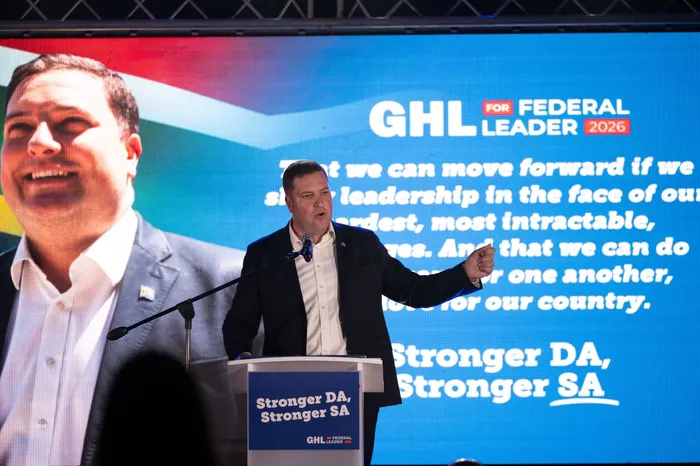
Cape Town Mayor Geordin Hill-Lewis addresses supporters and party leaders ahead of declaring his bid to succeed John Steenhuisen as leader of South Africa's Democratic Alliance (DA), at the Elsies River Civic Centre in Cape Town.
Image: Picture Henk Kruger / Independent Newspapers
Cape Town Mayor Geordin Hill-Lewis says his campaign will focus on expanding the DA's reach and building trust among voters who have never supported the party before.
Hill-Lewis officially entered the race to lead the DA, launching his campaign on Thursday.
Hill-Lewis said his decision came at a pivotal moment for both the party and the country.
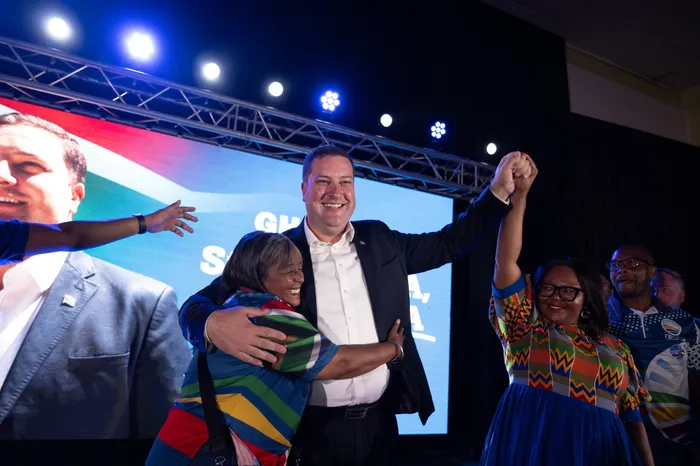
Cape Town Mayor Geordin Hill-Lewis addresses supporters and party leaders after declaring his bid to succeed John Steenhuisen as leader of South Africa's Democratic Alliance (DA), at the Elsies River Civic Centre in Cape Town.
Image: Picture Henk Kruger / Independent Newspapers
"I know South Africa can work. And I want to help make it so," he said.
"That is why I am today announcing that I am standing to be the next leader of the Democratic Alliance."
His announcement follows DA leader John Steenhuisen’s decision not to seek re-election, opening the way for new leadership ahead of the party’s Federal Congress in April and positioning the DA for the next phase of national politics.
Hill-Lewis pointed to his record as mayor of Cape Town as proof that DA governance delivers measurable results, particularly in job creation.
"We have become the country’s leading city in the growth of new jobs, with 470,000 new jobs created in Cape Town, more than in all other cities combined. When cities work, people work."
At the same time, Gauteng DA leader Solly Msimanga has accepted his nomination for federal chairperson.
"The DA must now prepare to lead in this new era. For the first time in a democratic South Africa, the ANC has fallen below 50% nationally, with further declines in several provinces and municipalities," Msimanga said.
"I am standing not for position, but for purpose. By 2026, we will govern more municipalities. By 2029, we can position ourselves to become the largest party in South Africa and form the core of a national government."
Political analyst Andre Duvenhage said the leadership contest marks a significant turning point for the party following internal uncertainty and leadership changes, including the resignation of Deon George and Steenhuisen’s decision to step aside.
"The DA came out of a phase of highly uncertain circumstances," Duvenhage said, noting that several prominent figures, including Western Cape Premier Alan Winde and former Tshwane mayor Cilliers Brink, had been considered potential candidates.
"My perspective is that Hill-Lewis is the most widely supported candidate to make it," he said, adding that both Hill-Lewis and Msimanga could ultimately stand unopposed.
Duvenhage said the leadership shift represents a generational transition within the DA.
"It is also interesting to see the DA go into a new era with a new generation of leaders. It’s no longer the Leon and Zille category of leaders. There are new ideas and new thinking in a very challenging environment."
He warned that the party faces growing political competition and dissatisfaction among key voter groups, including farmers and coloured communities, where the Patriotic Alliance has made electoral gains.
Director of Surgetower Associates Management Consultancy, Siseko Maphosa, said Hill-Lewis’s candidacy came as a surprise but was made possible by Steenhuisen’s decision to step aside.
"Hill-Lewis previously signalled that he would not contest if Steenhuisen remained in the race. Steenhuisen’s departure has, therefore, not merely opened the field but deliberately paved the way for Hill-Lewis," Maphosa said.
He added that Hill-Lewis appears to have strong backing within key party structures and among influential supporters.
"It is increasingly evident that he commands the confidence of the DA’s core constituency in the Western Cape and its major funders," he said.
Maphosa said Hill-Lewis is likely to secure victory.
Political analyst Dirk Kotze said Hill-Lewis’s candidacy had been widely expected and would likely reshape the party’s internal balance of power.
"He was widely expected to be a front runner for this. To a large extent, it is almost easy to conclude that he will be the DA federal leader," Kotzé said.
He noted that Hill-Lewis intends to remain mayor of Cape Town if elected, meaning he would not serve in Parliament or in the Government of National Unity.
"This means that the DA will have to appoint a parliamentary leader," Kotzé said.
He added that Hill-Lewis’s leadership would likely shift influence back to the Western Cape.
"The balance of power will now go back to the Western Cape within the internal context of the DA," he said.
"The last time the federal leader was in the Western Cape, it was Helen Zille. The majority of the DA’s support base is in the Western Cape and Gauteng."
Cape Times