

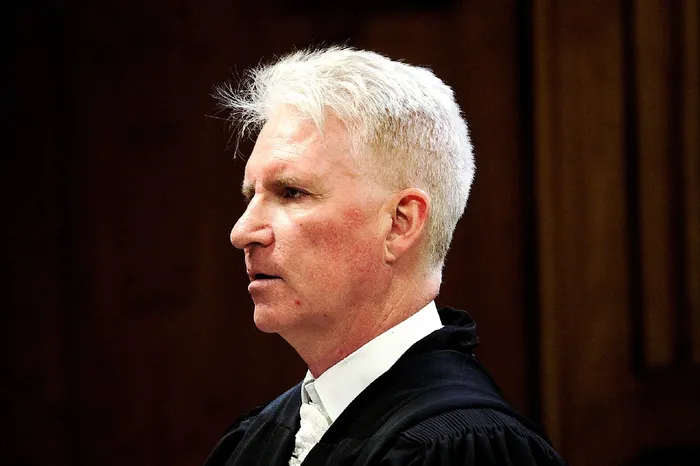
Advocate Douglas Shaw.
Image: Timothy Bernard / Independent Newspapers
WHAT was supposed to be the start of the long-awaited R60 billion class action against the country’s major banks took a dramatic turn when it emerged that the lawyer representing the scores of dispossessed homeowners was not in possession of a licence to practice.
Proceedings were just about to begin when counsel for First Rand Bank, one of the respondents, told Judge Leonie Windell that his attorney received an anonymous call on Monday, informing him that Douglas Shaw, the lawyer representing the homeowners, did not have a Fidelity Fund Certificate for this year.
The judge was told that the attorney who was tipped off contacted the Legal Practice Council (LPC) - the umbrella body that has to issue these certificates. In turn, the LPC confirmed that Shaw, according to its records, did not have such a certificate for 2026.
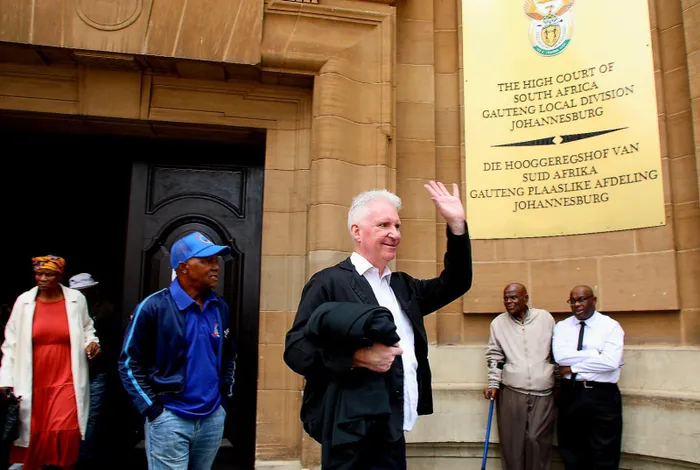
Lawyer Douglas Shaw leaving the Johannesburg High Court amid cheers from his clients in the R60 billion class action case against major banks.
Image: Timothy Bernard / Independent Newspapers
Judge Windell was told that not only was it obligatory for Shaw to have this certificate if he wanted to represent clients in court, but it was also a criminal offence to litigate without it.
A Fidelity Fund Certificate is a mandatory annual licence for legal practitioners (attorneys and certain advocates) in South Africa, confirming they are authorised to operate a trust account and handle client funds. It is issued by the LPC and protects the public against theft of funds.
The judge could not allow Shaw to represent the applicants without the certificate and gave him until this morning to produce it.
If he cannot produce the certificate, it will hamper the certification application severely, as he will not be able to argue it. Proceedings will therefore proceed without him.
Shaw later indicated that he was heading to Pretoria to sort out the issue regarding the certificate with the LPC.
The certificate was but one of Shaw’s woes. He was also found to be in contempt of court following a complaint from Absa’s counsel that he referred to affidavits and other documents in his application, after he was earlier barred by the court from using these documents.
Judge Windell was told that the bank had warned Shaw recently to remove references to these documents from the court papers, else he would be facing contempt of court. This was, however, not done.
Shaw responded that it was a mistake from his side and that he is not “willfully” in contempt of court. He issued an affidavit to the judge in which he explained how it came about that he had not removed these offending documents as of yet. He also gave an undertaking that it will be removed before today’s court proceedings.
Judge Windell said she will rule later on whether he was in willful contempt of her order. But she pointed out that this class action application has been long-awaited by the parties.
If Shaw can produce his Fidelity Fund Certificate by 9am on Wednesday and if she finds he is not in full contempt of court, there is a chance that the main application can go ahead this week.
The certification action was instituted six years ago against four of the country’s major banks and other bodies. They only managed to obtain a court date for this week, and the hundreds of applicants pin their hope on Shaw for redress.
Their case is that the banks sold their properties for amounts substantially less than their market value, or not as a last resort. They said that on this basis, the banks are liable for the losses they have suffered as a result.
The banks, represented by several senior advocates, are opposing the application.
Cape Times