

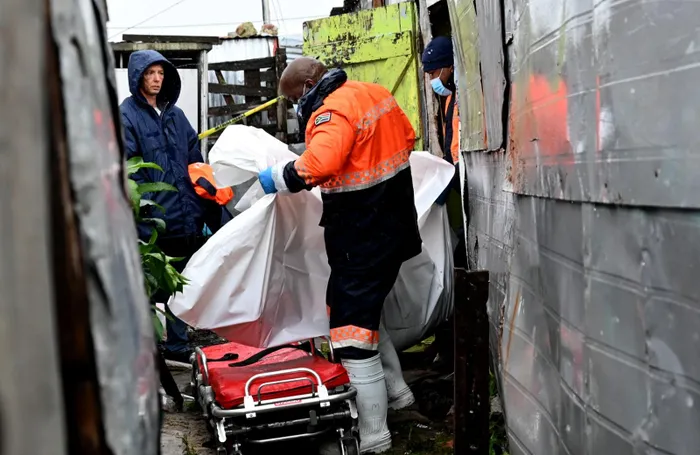
The crime scene in Kanana Informal Settlement, Gugulethu.
Image: Ayanda Ndamane / Independent Newspapers
THE Western Cape continues to carry a disproportionate share of gang-related violence in South Africa, and the rise in attempted murder remains a serious concern.
Organised crime, including extortion and firearm-driven violence continues to place immense pressure on vulnerable neighbourhoods.
The provincial government said the latest quarterly crime statistics for the Western Cape once again show that a complete reform of South Africa’s policing system and proper funding for law enforcement agencies are needed to meaningfully reduce violent crime.
Premier Alan Winde and Police Oversight and Community Safety MEC, Anroux Marais, have cautiously welcomed the 3.4% decrease in the province’s overall murder rate for Quarter 3 of 2025/26, which they say represents a decrease of 41 murders over this period.
“While there has been a decrease in the murder rate, far too many of our residents are dying at the hands of gangsters,” Winde said.
“The evidence is clear — cooperative, locally managed policing works. These proven programmes must be urgently funded by the national government and rolled out in every single policing precinct without delay. We will continue fighting for fair resource allocation for our province.”
Mayor Geordin Hill-Lewis said the City has taken some encouragement from a moderate reduction in violent crime, particularly in LEAP deployment areas, but reiterated that metro police stand ready to help the SAPS and NPA improve the conviction rate for gang, gun and drug crime.
Fight Against Crime Spokesperson Jay Jay Idel said while any reduction in violence is welcome, the province’s own statement acknowledges that gang violence, attempted murder, and firearm-related crime continue to place immense pressure on communities. This is where the contradiction lies.
“The Western Cape Government maintains that where it intervenes, murder rates decline. Yet those same communities remain trapped in cycles of gang recruitment, poverty and violence. The brutal truth is this: statistics don’t bury children, bullets do,” Idel said.
“The continued strength of gangsterism raises serious questions about whether provincial policies have meaningfully addressed the root causes, or whether the focus has remained on policing while the social vacuum that feeds gangs remains untouched.”
Idel said policing alone cannot solve a problem created by social and economic failure.
“Until provincial interventions begin to meaningfully disrupt the conditions that allow gangsterism to thrive, SAPS will remain locked in a reactive battle, and communities will continue to pay the price.”
Bishop Lavis Crime Prevention Forum Graham Lindhorst, said: “Our view is that even though there's a decrease, it is common knowledge that the Western Cape has shown a much lesser decrease amongst the other provinces.
“And it tells you that in the Western Cape, we have a problem. That's why we sit with 10 policing precincts, which are in the top 30, now for a very long time. And it's consistently the same precincts, number one, number two, it is policing precincts that are in our poorest of the poor areas,” Lindhorst said.
Unite for Change Leadership Council Member & GOOD Secretary-General, Brett Herron, said the Western Cape was the only province with 10 police stations in the top 30 murder stations of the country. Of the 276 gang murders, 257 occurred in the Western Cape, Herron said.
“And those are almost all attributed to 10 stations within the Cape Flats. That’s 93%. If gang murders were an exam, the Western Cape would finally be number one in the province.”
Cape Times