

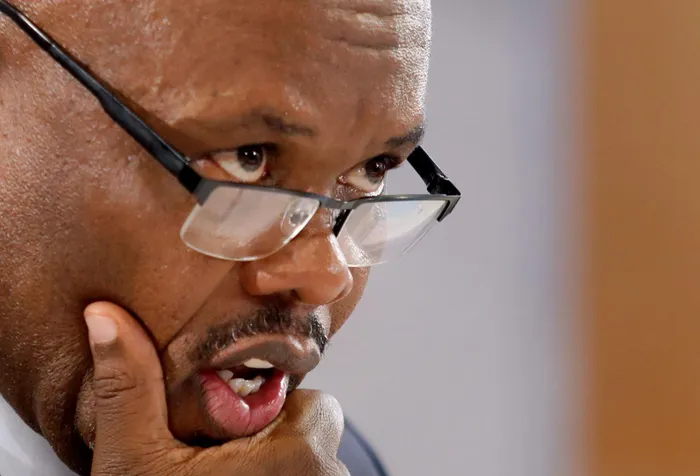
Suspended Deputy National Commissioner Shadrack Sibiya has denied involvement in transferring politically sensitive dockets, distancing himself from the allegations.
Image: Oupa Mokoena/Independent Newspapers
SUSPENDED Deputy National Police Commissioner Shadrack Sibiya attempted to downplay the impact of the Political Killings Task Team (PKTT), saying most dockets removed from the elite unit were "already stagnant" at time they were taken away.
Only 18% of them were recorded on the last day of investigation in 2025 while a further 21% were last investigated in 2024, and 22% date back to 2023, Sibiya told the Madlanga commission on Wednesday.
He said it was “a lie” that the PKTT was effective in its work, citing an example of a docket that took five years to conclude, despite a two-year target.
The PKTT was disbanded by police minister Senzo Mchunu on December 2024, a decision that led to KwaZulu-Natal Police Commissioner Nhlanhla Mkhwanazi speaking out against alleged attempts to capture the SAPS by criminal cartels.
Mkhwanazi accused Mchunu of playing a central role in enabling criminal cartels to infiltrate the SAPS, an allegation Mchunu has repeatedly denied.
Mkhwanazi implicated Sibiya in leading the efforts to have the 121 dockets the PKTT was investigating removed, only to be kept in his office at SAPS headquarters in Pretoria.
In his testimony on Wednesday, Sibiya said it was PKTT head Lieutenant General Dumisani Khumalo who issued an instruction that the dockets be moved from KZN to Gauteng.
Sibiya testified that he was not involved when the 121 dockets were handed over and were under SAPS head office control for three months.
"We didn't take the dockets, store them at the head office and they are gathering dust somewhere in my office. I have never seen even a single docket, to date. I have not seen even one. They have never been in my office. I don't have a safe in my office nor an archive."
He told the commission that attempts were made to return the dockets to KZN but Mkhwanazi rejected the offer.
“The fact that Mkhwanazi rejected those dockets, on its own, should not have been allowed," he said.
Mkhwanazi had claimed that at the time of the dockets removal from KZN five of the removed dockets had instructions to arrest suspects, but no action was taken while they were under Sibiya's control.
Sibiya accused Mkhwanazi of attempting to tarnish his reputation. He also criticised Mkhwanazi’s claim about swift arrests made within a week of the dockets being returned to KwaZulu-Natal last year, labelling the assertion as "incongruous and unimpressive".
He pointed out that the PKTT failed to obtain signed J50 forms to make arrests for more than three years.
Sibiya told the commission that he was unaware Mchunu would disband PKTT on December 31, 2024, but was not surprised by the decision.
According to him, SAPS National Commissioner Fannie Masemola did not oppose the PKTT disbandment because the subject of disbandment formed part of a meeting of November 1, 2025, which was one of the consultative meetings.
Existing task team structures, including the 2018 PKTT, were set to be replaced by provincial robbery and murder units, according to a study group's recommendations, he said.
This version corroborates Mchunu’s testimony two months ago that if Masemola had approved the new organisational structure based on the 2019 work study, the PKTT would have been dissolved back in March 2024.
Masemola told the commission last year that he deemed as “unlawful” a directive by Mchunu to disband the PKTT, saying he reached out to President Cyril Ramaphosa for intervention.
Sibiya told the commission that his role in the disbandment of the PKTT was “undertaken solely in the course of and instructions issued to me by the national commissioner”.
He testified that Professor May de Haas lodged a complaint with Mchunu on October 31, 2024, alleging PKTT was abusive and wasted resources, with these issues arising under Mkhwanazi's leadership. De Haas called for the PKTT's disbandment and a judicial probe into its operations.
Cape Times