

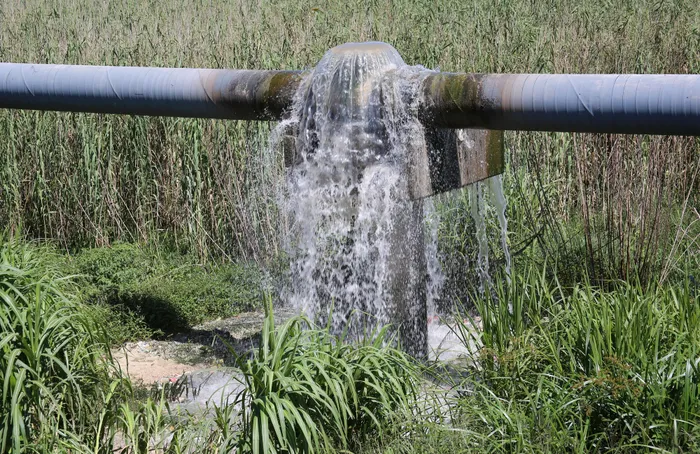
UMngeni-uThukela has appointed a service provider to help detect leaks in the eThekwini Municipality's system amid concerns about the losses and their impact on the municipality.
Image: Tumi Pakkies / Independent Newspapers
THE country’s eight metros have recorded R8.66 billion overall water losses, with an average loss of 34.6% which significantly exceeds the acceptable benchmarks and highlights systemic inefficiencies considered highly problematic.
The benchmark makes provision that water losses should be between 15 and 30%, according to the recently released National Treasury’s State of Local Government Finances and Financial Management report.
Anything above signals serious distribution inefficiencies, widespread theft, and deteriorating or fractured infrastructure within municipal networks.
“The highest percentage losses were observed at eThekwini at 53.8% and Mangaung at 49%, meaning that over half of the water purchased by eThekwini cannot be billed.
“These significant losses point to systematic challenges such as ageing infrastructure, frequent pipe bursts, illegal connections, or weak monitoring and control mechanisms,” reads the report. While the City of Johannesburg lost 35% of its water, it was the highest financial loss at R2.9 billion.
“Even though this was not the highest percentage loss, the financial magnitude of such a loss is alarming. The best performer is the City of Cape Town, with only 5.9% of water losses, which reflects strong water management practices, leak detection, and billing controls.
“The City of Cape Town is clearly outperforming the other metropolitan municipalities,” Treasury stated.
The report also shows that the accumulated level of unauthorised, irregular, fruitless, and wasteful expenditure (UIFWE) in the metros was R96.4bn, with the unauthorised expenditure amounting to R26.1bn, irregular expenditure of R65bn, as well as fruitless and wasteful expenditure amounting to R5.3bn.
Nelson Mandela Bay, Johannesburg, and Tshwane – together accounted for 71.4% (or R68.8bn) of the combined UIFWE.
Nelson Mandela Bay incurred about R24.4bn (25.3% of the combined UIFWE of metros), Johannesburg R23.61bn (24.5% of the combined UIFWE) and Tshwane was responsible for R20.81bn (21.6%, of the combined UIFWE).
“There is a high level of concentration among the top three metropolitan municipalities, which collectively account for R7 out of every R10 of UIFWE reported in the dataset,” the report explained.
The largest contributor to unauthorised expenditure is the City of Johannesburg (49.6% or R12.94bn), followed by Mangaung (33.7% or R8.81bn).
Unauthorised expenditure is described as spending that was not approved in the budget, and reports have shown that the large UIFWE aggregates attract adverse findings from the Auditor-General of South Africa and may cause audit qualifications, impact fiscal credibility, and hamper service delivery.
Additionally, the significantly high unauthorised expenditure in the Johannesburg and Mangaung metros is indicative of budget control failures, unauthorised virements (re-allocation of public funds from one account to another), or expenditure without proper council approval.
“The financial impact is that the unauthorised expenditure directly weakens fiscal control and may require corrective budgetary measures; repeated or large unauthorised expenditure can lead to poor cash management and audit qualifications,” Treasury warned.
The Nelson Mandela Bay Metro was also the biggest contributor in irregular expenditure, with R22.2bn or 34.2%, followed by the City of Tshwane at R15.5bn or 23.9%, and Buffalo City, which reported R10.5bn or 16.2%.
The report explained that irregular expenditure typically arises from non-compliance with procurement rules, contract irregularities, or failure to follow statutory processes.
It added that the dominance of irregular expenditure (at 67% of the total UIFWE) suggests systemic supply chain management problems at several metros.
Cape Times