

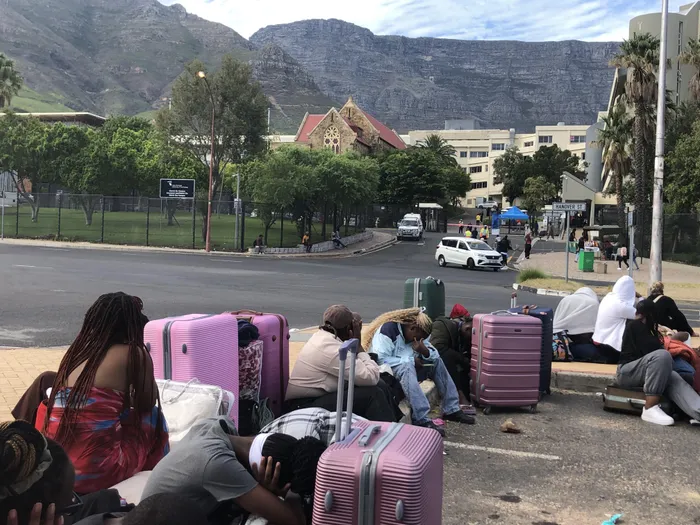
Several students were seen sitting opposite the university’s entrance gate, appearing exhausted, distressed and despondent.
Image: Lilita Gcwabe
Some registered students at the Cape Peninsula University of Technology (CPUT) have been left stranded outside the District Six campus since the start of lectures, saying they were forced to move between the street and temporary accommodation.
CPUT has however denied claims that students are sleeping outside and said it has placed 400 students in temporary accommodation to prevent this.
Several students were seen sitting opposite the university’s entrance gate, appearing exhausted, distressed and despondent. Some refused to speak to the media, fearing that doing so might jeopardise their chances of securing accommodation or lead to their parents finding out about their situation.
First-year student from Limpopo, *Patience Mavimba, said she has kept her phone switched off since arriving in Cape Town on Monday morning. She explained that she spent the entire day outside the campus and was only placed in temporary accommodation at around 1am.
“I know my parents are worried because they haven’t been able to reach me since I arrived,” she said. “But I don’t want to switch my phone on because I don’t know what to tell them. I don’t know where I would say I am or how I would explain how school is going.”
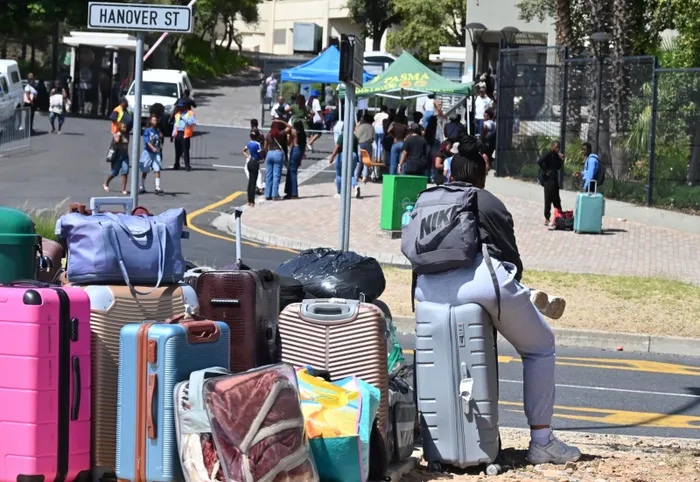
Despite recent efforts by CPUT to provide temporary housing, many students remain without stable accommodation as classes approach.
Image: Ayanda Ndamane
Mavimba said she had high hopes for the beginning of her first year at university. After being accepted to study, receiving NSFAS funding and travelling to Cape Town, she believed the most difficult part of her journey was over.
“It has been very depressing since I arrived,” she said. “We spend the whole day on the street, then at night we are taken to temporary accommodation. We sleep for a few hours and are sent back outside again until midnight or even later.”
She said she has considered returning home but feels she has no choice but to stay because she wants to continue her studies and improve her life and that of her family.
Chairperson of the EFF Student Command, Luyanda Dlamini, said student leaders have struggled to assist students in securing accommodation.
"The students who are here are registered, and many applied before the deadline, yet they are still sleeping outside, missing classes and have nowhere to stay," Dlamini said.
"The number of available beds does not match the number of students who need accommodation."
He accused the university of poor planning and failing to prioritise student safety and well-being. Dlamini said on-campus residences are the preferred option for many students because they are safer, more affordable and allow students to focus on their studies.
"We are against private accommodation because students face many challenges," he said. "These places are far from campus, transport is expensive, and some are unsafe. The conditions are often unsuitable for students, and landlords demand upfront payments that students cannot afford."
Dlamini added that some private residences accommodate up to five students in a single room. He also claimed that students staying in private accommodation are disqualified from applying for on-campus residence.
"As a result, many students take risks because they are desperate to secure a place on campus," he said.
CPUT denied claims that students are sleeping outside and said it placed 400 students in temporary accommodation.
"These are individuals who arrived without confirmed or secured residence placements, and we are doing everything possible to assist them," said CPUT spokesperson Lauren Kansley.
"No one sleeps outside at night, including those who are not eligible for residence."
According to Kansley, CPUT currently accommodates 16 200 students in university owned and operated residences, while 4 000 students are housed in private accommodation.
"There are enough beds for students,” she said. “CPUT has reached its capacity in terms of residences it can own and operate, and there are currently no plans to build additional residences."
Kansley acknowledged that the university’s residence appeal process can be lengthy, resulting in many students having a “pending” status.
"When students arrive without having applied for accommodation, it puts pressure on the system, and in some cases we have to consider accommodation that does not fully meet operational requirements," she said.
However, Kansley insisted that "no academically deserving student will be excluded from their studies because of accommodation challenges."
Cape Times