

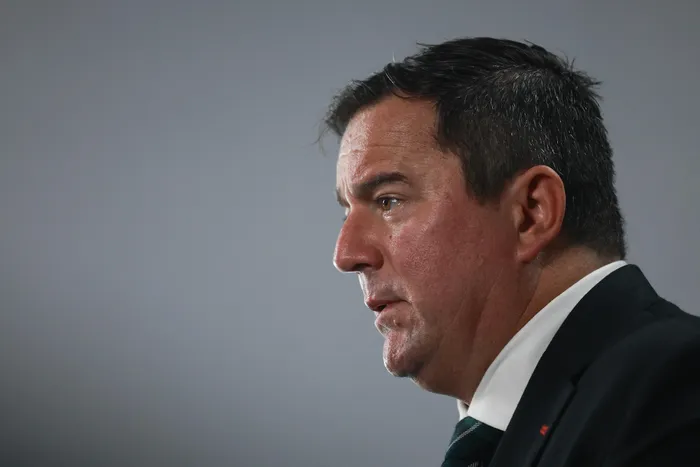
DA LEADER John Steenhuisen is expected to announce he will not seek re-election at the party’s elective congress later this year.
Image: AFP
CAPE Town Mayor Geordin Hill-Lewis’s name has been thrown in the mix of leaders likely to replace John Steenhuisen when the party holds its elective congress later this year.
Steenhuisen reportedly intends to announce that he will not run for re-election during the party’s federal congress.
The development comes weeks after a DA investigation cleared Steenhuisen of allegations linked to the misuse of a party-issued credit card. Former DA federal finance chairperson Dion George had leveled serious allegations against Steenhuisen and revoked his access to the credit card due to unreconciled personal expenses.
However the preliminary investigation led by the Chairperson of the Federal Legal Commission, Glynnis Breytenbach found that the expenditure on the card had been fully reconciled, that there was no prima facie evidence of misappropriation, and that the limited number of personal expenses had been adequately explained and reimbursed.
The fallout led to George’s resignation, and he accused the party of being captured by the ANC and other criminal interests under Steenhuisen’s leadership.
Steenhuisen’s imminent exit from the top post now places the DA under pressure to present a leader who can broaden its appeal beyond its traditional base.
Political analysts say the leadership contest will test whether the party can position itself as a credible alternative government rather than a permanent opposition.
Hill-Lewis and Gauteng opposition leader Solly Msimanga have emerged as two names likely to be frontrunners.
Analysts suggest that Steenhuisen’s decision not to run has fundamentally reshaped the race.
Political analyst Professor Bheki Mngomezulu said Steenhuisen’s withdrawal has “opened a Pandora’s box”, despite assurances from DA Federal Council Chairperson Helen Zille that the party will not fracture during the succession process.
“There was no clear indication that Steenhuisen would pull out of the race,” Mngomezulu said. “His withdrawal creates space for almost anyone to emerge. It could even open the door for someone like Solly Msimanga.”
Mngomezulu cautioned, however, that the final outcome may hinge on uncomfortable realities around race and internal party dynamics.
“The DA always says race and gender do not matter, but that is theory,” he said.
“If it comes down to a straight contest between Geordin Hill-Lewis and Solly Msimanga, then Msimanga will struggle.”
Another analyst, Professor Kedibone Phago, said Steenhuisen’s exit may be linked to mounting internal pressure following the fallout with George, who accused the party of lacking transparency and honesty.
Behind the scenes, relations between Steenhuisen and George had deteriorated sharply. Their disagreements centred on strategy, communication, and the DA’s role in the Government of National Unity (GNU).
Phago believed that, despite Zille publicly backing Steenhuisen during the dispute with George, recent developments suggest that influential factions within the party no longer see him as the right leader for the road ahead.
“It means there is a faction, led by Zille, that believes he is not the right fit,” Phago said. “They know the ANC is weakening and they see an opening. That is why the DA is aggressively targeting Johannesburg. This is strategic.”
He added that Steenhuisen was unlikely to attract the black middle class that the party now needs to grow.
“I am not surprised he stepped aside. He was never going to be the leader when it mattered most,” Phago said.
Cape Times