

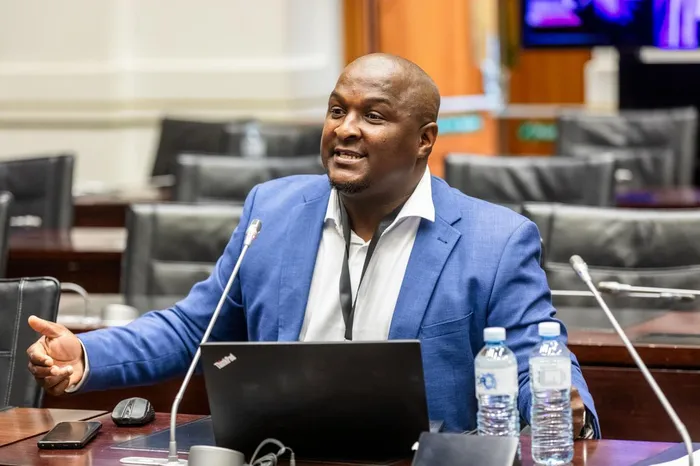
Former Crime Intelligence officer Pilasande Dotyeni giving testimony before the Ad Hoc Committee investigating allegations made by KwaZulu-Natal Police Commissioner Lieutenant-General Nhlanhla Mkhwanazi.
Image: Zwelethemba Kostile / Parliament of RSA
A FORMER Crime Intelligence officer suspects that foul play may have been behind the death of deputy national commissioner of crime detection, Sindile Mfazi.
The official explanation for his death was that Mfazi died “due to Covid-19-related complications” in 2021.
Former warrant officer Pilasande Dotyeni disclosed that Mfazi died at the time he was investigating the Secret Services Account in connection with the R1.6 billion Covid-19 Personal Protective Equipment.
He told the Ad Hoc Committee this week that Mfazi had continued to probe further what was happening at the SAPS headquarters when he was moved to the Western Cape.
“When one of those generals is assassinated and buried under the lie of Covid-19 demands of us as citizens to speak to those who are in power, to plead with them to do something. It has been five years,” he said.
He also said Mfazi had made contact with him at the beginning of 2020, asking him to record senior police officers in a certain office to understand what was being done there.
“There are people who know, and I will point this committee in the right direction,” he said.
“I would like to make these disclosures in a proper forum. That is important because it is a responsible investigation. I should not speak as if I am not conscious of the threats out there,” said Dotyeni, who served in Crime Intelligence between 2004 and 2012.
He told the MPs that he had been notified by one of Mfazi’s drivers about this death, and his wife had confirmed it.
“As she was speaking to me, you could hear there were people around her, and she was saying leave the cellphone, you are not to have it.”
Dotyeni stated that the driver had confirmed that there were people from SAPS head office who were taking Mfazi’s documents while his body was upstairs.
“They had not cleaned the blood that was there when they were taking these files,” he said.
“There was blood, which is what brought these suspicions of foul play. The family was not happy, and thank God the family went as far as court after the funeral to have a post-mortem so that there is forensic evidence that demonstrates what they suspected.”
Dotyeni added that after Mfazi’s body was exhumed, a post-mortem was done and an inquest was opened.
“They found that there was casting resin in his system, which meant this man had been poisoned with casting resin, which explains why there was blood in that room because the man was choking in his own blood.”
He alleged that the SAPS headquarters took the inquest docket for investigation.
Dotyeni told the Ad Hoc Committee that the investigation was dying a slow death.
When Evidence Leader Bongiwe Mkhize said Dotyeni did not provide supporting documents to the committee, Dotyeni said forensic evidence was a fact.
“An inquiry was done at Cambridge police station. It exists within SAPS. Within the docket, you find the forensic report. Within the same docket, you find a witness who details who the people were who came to take various files that were there. All the information is there.”
Dotyeni also said there was a certain level of expectation when matters like Mfazi’s death happened.
“For as long as the head office is a crime scene, you can't have a docket to be investigated when everything and there are implicated people there.”
He asked the committee to demand full disclosure about who authorised the retrieval of documents from Mfazi’s home, what became of the toxicology report, who he was investigating, and why the investigation stopped.
Cape Times