

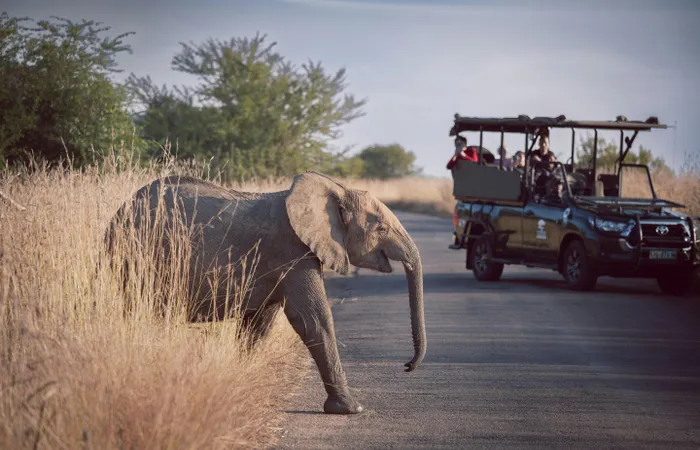
The Supreme Court of Appeal ruled that a tour operator cannot hide behind indemnity forms after a tourist was injured during a safari.
Image: Unsplash
The signing of an indemnity form and a disclaimer does not exempt a tour operator from liability after an Australian tourist was injured when she had lost her balance and fell from a safari vehicle.
The matter came under the judicial spotlight in the Supreme Court of Appeal (SCA) after the Gauteng High Court earlier ruled in favour of Anu Murti that Tourvest Holdings is liable for her damages.
The company subsequently turned to the SCA, relying on disclaimers in brochures sent to her life partner before the safari commenced.
Her partner, who had organised the safari for Murti as a birthday surprise, signed the indemnity form and disclaimer on behalf of both of them.
The SCA found that the tour operator cannot rely on an indemnity signed by the partner on behalf of Murti.
The incident happened in 2018 when Murti was travelling in a safari truck in Botswana, as part of a Southern African safari tour arranged by Tourvest Holdings, trading as Drifters Adventours.
The truck had been converted to transport 17 passengers and its driver, with large side windows to facilitate viewing by its occupants. It is fitted, in the rear of the passenger compartment of the truck, with private lockers to secure the belongings of passengers. Drifters promote the lockers as being accessible to passengers, even while the truck is being driven. While the truck was in motion, Murti moved from her seat to access her locker.
She lost her balance and fell against a window. The window fell out of its frame, and she fell through the opening onto the tar road and sustained various injuries. In her damages claim in the High Court, Murti alleged that her injuries were caused by the negligence of Drifters and its employee and the driver of the truck.
Drifters relied on two disclaimers in arguing that it was not liable for her damages. According to the tour operator, Murti knew about the disclaimer and that she had signed it before embarking on the tour. In ordering in her favour, the High Court, however, found that Murti was not bound by the terms of the disclaimers.
It is not in dispute that her partner, at a stage, completed an indemnity form by inserting Murti’s details and signing it himself. Murti denied that she had any knowledge of this form, or of her partner completing and signing it.
The High Court concluded that Murti did not sign the form and that in any case, Drifters was not exempted from liability by reason of the disclaimers or of the indemnity form. It found the disclaimer was of such a general and unspecified nature that it could not, on its own, absolve Drifters of negligence.
Regarding the second disclaimer, it concluded that her partner was not authorised to conclude the indemnity on Murti’s behalf and that she was not bound by it. The SCA agreed with this, and Judge Piet Koen, who wrote the unanimous judgment, found it was incumbent on Drifters to ensure that it concluded separate binding agreements with each tour participant.
It is an obligation that should not be approached casually, to ensure that whatever documentation was required was properly completed in respect of each participant, the judge said. He added that this process should have been closely supervised by the driver, or representative of Drifters, or by at least an identifiable witness co-signing and confirming that the signatory to each indemnity form was indeed the person whose particulars were inserted on the form before embarking on the safari.
He subsequently turned down the appeal. The next step will now be for the High Court to decide on the amount of damages payable to Murti.
The Supreme Court of Appeal ruled that a tour operator cannot hide behind indemnity forms after a tourist was injured during a safari.
Image: Unsplash