

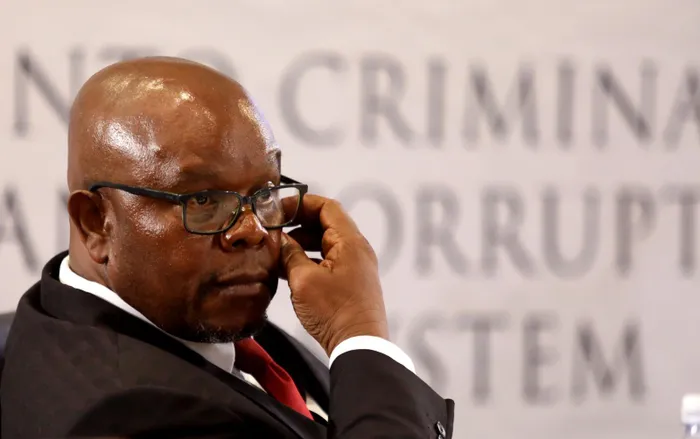
KwaZulu-Natal Hawks head Major-General Lesetja Senona testified before the Madlanga Commission about the unsolved R200 million cocaine theft.
Image: Oupa Mokoena/Independent Newspapers
KWAZULU-NATAL Hawks head Major-General Lesetja Senona maintained that he took ‘sufficient’ steps to secure the cocaine worth about R200 million that was eventually stolen from a Port Shepstone storage facility with no alarm system.
Senona said he lost oversight of the investigation into the 2021 Port Shepstone cocaine heist after the case was taken over by the national SAPS office.
He said the docket and inquiry file were transferred to the national office, effectively removing his unit from the case.
He said the national office had since established a task team to work on the docket but according to his recollection, it has not reported any breakthrough to date.
“I must tell you that it is difficult for me to check the progress because even when the team visited KwaZulu-Natal they never told me they were there,” he told the inquiry, adding that he does not know the current status of the case.
He recounted that on June 22, 2021, a captain from border security contacted his Durban office with information on a possible cocaine shipment at Isipingo depot, near the harbour. He said the information was urgent, so he sent members of his office and Operations Response Services Border policing to the scene.
“Upon inspection they discovered 27 canvas bags found within the container. Each bag contained around 20 bricks of cocaine. Each brick weighs 1kg. The bricks of cocaine were wrapped in a black and yellow plastics. The total mass of the brick amounted to 541kg and the street value of R200 million,” he said.
Senona said the Hawks team went to Isipingo police station to store the seized cocaine, but were told there was no storage space available. They had to search for an alternative, eventually using a storage facility in Port Shepstone.
The commission grilled Senona over the lack of full-time security at the Port Shepstone storage facility, raising concerns about how a high-value exhibit like 541kg of cocaine was secured.
He claimed he issued an instruction to monitor the facility, but the commission heard conflicting accounts from police officers’ affidavits regarding an instruction to patrol the area.
According to one affidavit, an officer expressed unhappiness that the drugs were taken to the storage despite that it was not safe.
The officer explained that the Port Shepstone storage had an alarm system, but it was discontinued due to non-payment. A message from the national office confirmed the alarm was removed from the system in December 2020, leaving the facility without active security monitoring.
“It is an unfortunate situation that it was never brought to my attention,” said Senona, adding that according to him the alarm system was there.
One officer said in an affidavit that he could not recall receiving a direct instruction to monitor the storage facility. Instead, he said a request was made for officers to make a turn at the facility whenever they were in the area, suggesting a more casual approach to securing the R200 million worth of cocaine.
Senona dismissed the suggestion that he made a request, saying it was nothing like a request but rather an instruction he gave to officers through their supervisor.
Co-commissioner Advocate Sandile Khumalo SC said: “I thought it was reckless that there was no one going there to check those drugs for 24 hours.”
Asked about what he did proactively to secure the drugs, Senona said: “I didn't go and visit. If you are head of a national institution you have people who are doing work on your behalf. I have never gone there to check. At the time the steps I had taken were sufficient.”
He also confirmed that he has not undergone a polygraph test regarding the missing cocaine, but said he would comply if his superior ordered him to take one.
Cape Times