

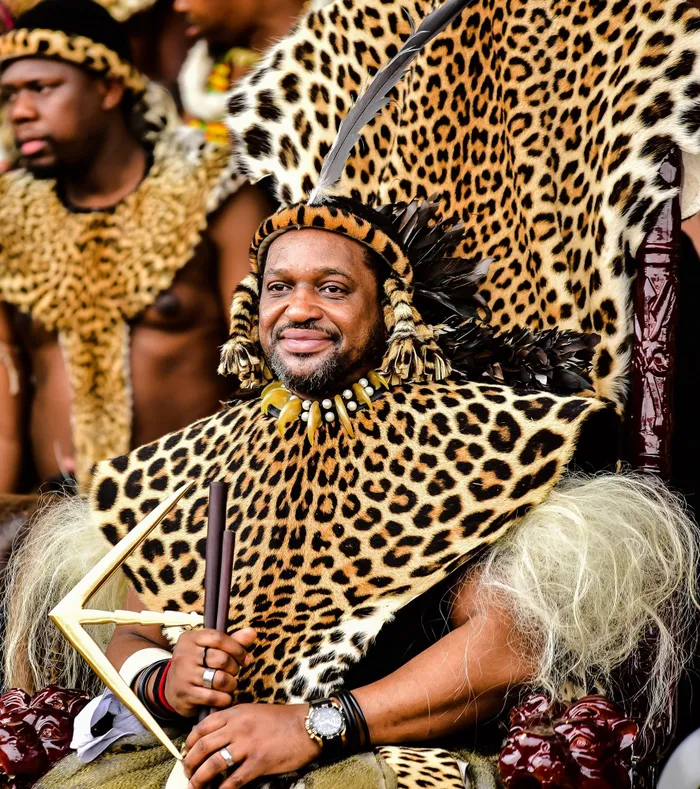
King Misuzulu's call for the name change of KwaZulu-Natal has receives the endorsement of the IFP.
Image: Supplied
THE IFP has become the first political party in the Government of Provincial Unity to throw its weight behind the Zulu king’s campaign to rename KwaZulu-Natal to KwaZulu.
Speaking at the 147th commemoration of the Battle of Isandlwana last week, King Misuzulu kaZwelithini announced that he would embark on a campaign to get Natal removed from the province’s name and that it should be known as KwaZulu (the place of Zulus).
The king's call received a backlash with cultural and political analysts arguing that dropping Natal and elevating one cultural community over others would have negative ramifications for unity and social cohesion.
However, the IFP in the KwaZulu-Natal Legislature has expressed its full support for the renaming of the province, describing it as both 'timely and historically justified'.
In a statement, the party’s chief whip Blessed Gwala said his party felt 'vindicated by His Majesty’s position'.
Gwala said it is well documented that during the Convention for a Democratic South Africa (CODESA) negotiations in the early 1990s, there was intense debate over the renaming of provinces, particularly Natal.
“We do not find anything sinister in the King’s proposal, as history tells us—and it is well known—that in the past, during the reign of King Shaka, who ruled over many tribes, the boundaries of KwaZulu extended as far as the uMtamvuna River in the Eastern Cape, Balfour in Gauteng, and Ermelo in Mpumalanga.
"The demarcation resulted in the loss of many parts of KwaZulu, which were placed under other provinces. This proposal therefore comes as no surprise and is neither unreasonable nor uncalled for,” read the statement.
Gwala who is also the IFP’s national chairperson said his party consistently and firmly advocated for the recognition of KwaZulu in acknowledgement of the Zulu Kingdom and its profound historical, cultural, and political significance.
“The current name remains a compromise that failed to fully reflect this reality. We further believe that His Majesty’s call opens the door to addressing other long-standing historical distortions, particularly the matter of Pietermaritzburg, which is referred to as uMgungundlovu. It is a well-known fact that uMgungundlovu was King Dingane’s royal palace near Ulundi, which was destroyed, after which the Voortrekkers named Pietermaritzburg a “fake” uMgungundlovu with the deliberate intention of mocking and ridiculing the Zulu people,” read the statement.
Cape Times