

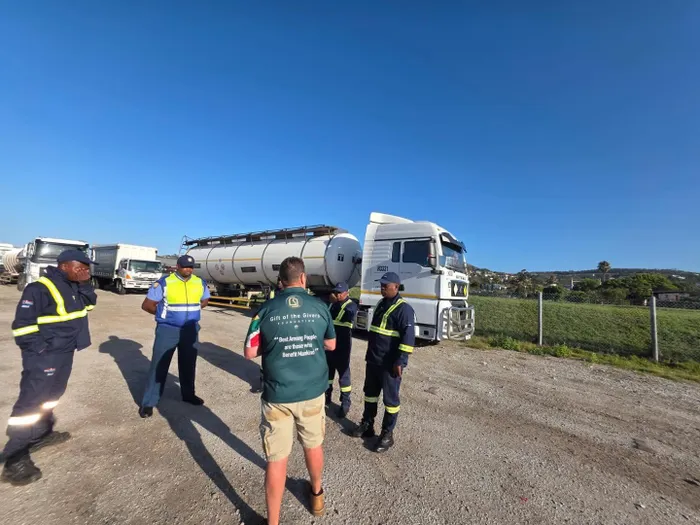
Water relief trucks are being escorted to the offload site at the Knysna Water Treatment Plant, reinforcing emergency efforts to stabilise the city’s water supply and help delay Day Zero.
Image: Gift of the Givers
The Joint Operations Committee (JOC) tasked with overseeing Knysna’s water situation has committed to installing 1 000 water meters per week going forward.
This intervention aims to replace approximately 8 000 bypassed meters, which are currently hampering effective water management in Knysna, said Local Government, Environmental Affairs and Development Planning MEC Anton Bredell.
In an update on Tuesday, Bredell said he was encouraged by the progress being made in addressing Knysna’s water crisis.
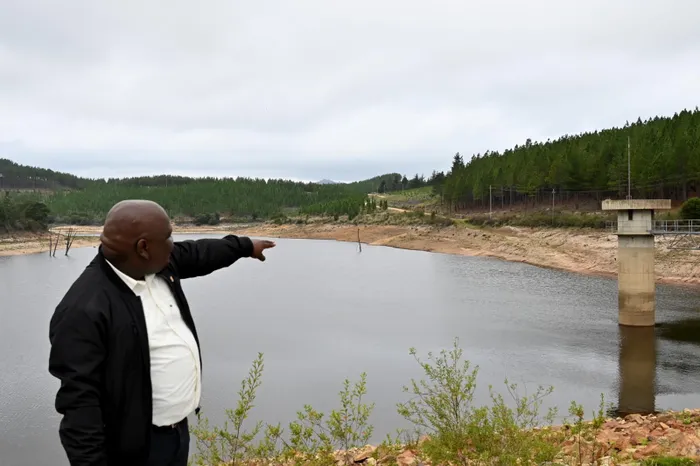
Knysna’s water buffer has improved to 17 days, with dam levels rising and repairs under way — but officials warn the town remains in disaster mode and residents must continue to save water.
Image: Ayanda Ndamane/ Independent Newspapers
The level of the Akkerkloof Dam has increased from 15% to 20.9%.
Current water usage in Knysna is approximately 10.1 kilolitres per day, translating into a water buffer of 17 days - an improvement from the 10-day buffer reported just two weeks ago.
Plumbing teams have repaired 29 minor water leaks, with no major pipe bursts reported in recent days. Water pumps across the system remain stable and were operating within their specification parameters. The Charlsford and Eastford pump stations were abstracting water from the Knysna River at a rate of 210 litres per second. The Akkerkloof pump station currently operates at 44 litres per second, while the Glebe Dam pump station is also pumping at 33 litres per second.
Bredell said the JOC is developing a fire hydrant repair plan to improve system integrity and fire-fighting readiness.
“I am pleased with the progress being reported. While the immediate focus is on Knysna, the entire Southern Cape region remains water-stressed, and current weather forecasts for the Western Cape point to a dry winter ahead. Effective water management in all our towns will be critical in the year ahead. We cannot control the rain, but we have full control over how we manage the water resources at our disposal,” Bredell said.
Gift of the Givers on Tuesday said their water trucks had arrived in Knysna and were being escorted to the offload site at the Knysna Water Treatment Plant, reinforcing emergency efforts to stabilise the city’s water supply.
The municipality said Knysna was facing one of the most challenging water periods in recent years.
“Our efforts depend on how responsibly every resident and business uses the available water.
“Strict and responsible water use by all residents, businesses, and visitors remains essential.”
As a water-saving measure, showers and external taps at ablution facilities and in public spaces remained closed. Residents were also urged to ensure that all taps are closed during water interruptions to prevent water losses once supply is restored.
Members of the public can report water leaks or incidents of water wastage to 044 302 6331 or 044 302 6334.
Cape Times