

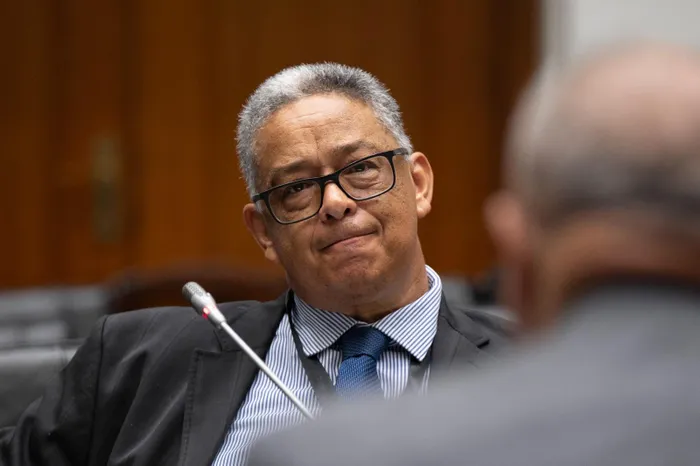
Former Independent Police Investigative Directorate head Robert McBride testified before Ad Hoc Committee investigating corruption, political interference, and criminal infiltration in South Africa’s criminal justice system.
Image: Armand Hough / Independent Newspapers
FORMER Independent Police Investigative Directorate (IPID) head Robert McBride has conceded that some of the information provided by forensic investigator Paul O’Sullivan was ‘useful although it did not influence investigations’.
“He did not influence us. No one on this earth can influence me. I always do the right thing,” he testified before the Ad Hoc Committee probing allegations made by KwaZulu-Natal police commissioner Nhlanhla Mkhwanazi, McBride.
“I never sought information from him,” he said.
Previous witnesses before the inquiry had claimed that O’Sullivan was in control of IPID and conducted some of its investigations.
However McBride said O’Sullivan was one of the sources of information.
“The fact that he provided information does not translate into controlling IPID. That is a fiction created by Phahlane. That is all they got. They got no explanation for charges they must face,” he said.
Former acting national police commissioner, Khomotso Phahlane previously MPs of a coordinated campaign, allegedly driven by McBride in collaboration with O’Sullivan, that led to the creation of the so-called “Phahlane Task Team” to destroy his reputation.
Earlier, McBride said he had known O’Sullivan since 2014 when he was appointed as IPID head.
“I met him in response to his provocation about what IPID’s predecessor had done to him. I never met him before.”
He assured MPs that O’Sullivan did not undertake work for IPID.
When asked what he understood to be work done by O’Sullivan, the former IPID boss said he was a certified fraud examiner.
“He was assisting with forensic analysis of documents and basically doing investigative journalism to uncover corruption.”
McBride said he never sought O’Sullivan’s assistance in the work of IPID.
“Some members of IPID might have engaged him. For me, he is someone with information. I would listen to him,” he said.
McBride told the Ad Hoc Committee that in engagements with O’Sullivan, he had stopped him twice when he overstepped his line.
In one instance, McBride said O’Sullivan tried to influence the arrest of certain persons who were under investigation by IPID after he apparently obtained insider information about an investigation.
He said he had told him that IPID followed evidence and handed a case to the prosecution authorities for a decision.
McBride denied that O’Sullivan accompanied IPID investigators when they conducted their investigation.
In the case of O’Sullivan visiting Phahlane’s house with IPID investigators, he said he was a complainant.
“Paul O’Sullivan showed IPID the alleged crimes at Phahlane’s house.”
He defended describing the house as a crime scene saying it was built with money from service providers.
“There is evidence money came in black plastic bags. Phahlane still stays in a crime scene,” said McBride.
When it was pointed out to him that crime may have been committed elsewhere at SAPS, not in the house, he said: “It is proceeds of crime.”
Cape Times