

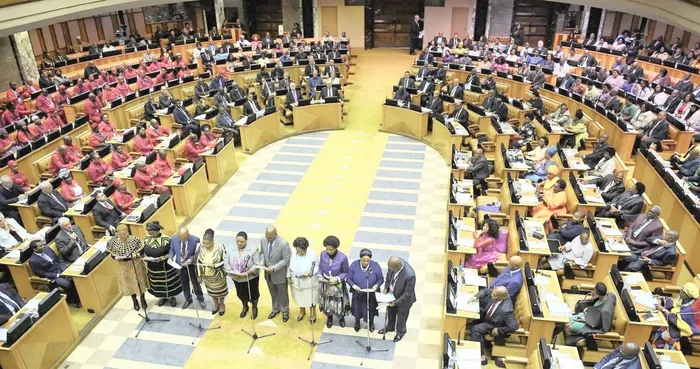
Analysts say the salary increases for ministers, deputy ministers, and parliamentarians are a sign that the government is no longer in touch with its citizens.
Image: Phando Jikelo / Independent Newspapers
THE approval of salary increases for of public office bearers, including ministers and their deputies, as well as parliamentarians, demonstrates that the government doesn’t care about the sufferings of the citizens.
This is according to analysts and experts who argue that the money should have been on improving infrastructure, especially the railways, which provide cheaper transport for the working class.
President Cyril Ramaphosa announced this week that he approved a 3.8% pay increase for ministers, deputy ministers, and parliamentarians.
The increases are set to take effect on April 1, 2026.
These increases are slightly lower than the 4.1% suggested by the Independent Commission for the Remuneration of Public Office Bearers.
However, provincial legislators will still receive the full 4.1%. This also applies to judges, magistrates, traditional leaders, and independent constitutional institutions.
Under the new changes, the deputy president now earns R3.28 million, an increase of R120,000. Ministers now earn R2.79m, which is R102,000 more. Members of Parliament who are backbenchers now earn R1.32m, an increase of R48,000. Members of executive councils now earn over R2.3m, up by R90,000.
Premiers’ salaries will surge from R2.53m to R2.64m, up by R104,000, and MECs from R2.22m to R2.31m (up R91,000).
Over 25 million South Africans, about 40% of the population, depend on social grants, with recent 2025 data from Stats SA showing 25.4m individuals relying on them.
The country’s poverty stats also show persistent challenges, with projections around 63.5% to 68% of the population living in poverty.
Unemployment, meanwhile, stood at 32%.
Political analyst Zakhele Ndlovu said Ramaphosa’s decision demonstrates how leaders are out of touch with the realities.
Ndlovu added that the money could also be used to create job opportunities.
Another analyst, Professor Andre Thomashausen, said South Africa only comes first with negative records, adding that rewarding an “incompetent” ministerial team with salary increases highlights that the government system has failed.
Professor Andre Duvenhage said this shows that the ANC is slowly becoming a traditional party, adding that there are political motives behind the decision to increase salaries.
He said this has to do with the upcoming local government elections, as politicians want something for their votes.
Duvenhage added that the decision is unjustifiable.
“You must read it within a strategic context,” he said, adding that the office bearers will have to perform to justify the increases.
Duvenhage said that, due to various national crises, including the economy, it would be a viable option to take voluntary salary cuts to promote economic growth.
“We are already overpaying within the civil service, and in return, we are not getting much. We are overpaying and instead of doing the job, they hand out contracts for other people to do the job,” he said.
Governance expert and political analyst, Sandile Swana, said: “They need to enjoy the lavishness under all circumstances, and South Africa is an animal farm. All the elites want to be equal among themselves but never equal to us - the citizens.”
He said the performance of the Government of National Unity (GNU) and Ramaphosa’s administration so far have been disastrous economically and financially for the citizens.
“The schools are in a state of disaster. Our schools, especially in Black communities, are a total catastrophe,” he said, adding that to claim that there is a performance or inflation-related increase is to ignore the facts.
Cape Times