

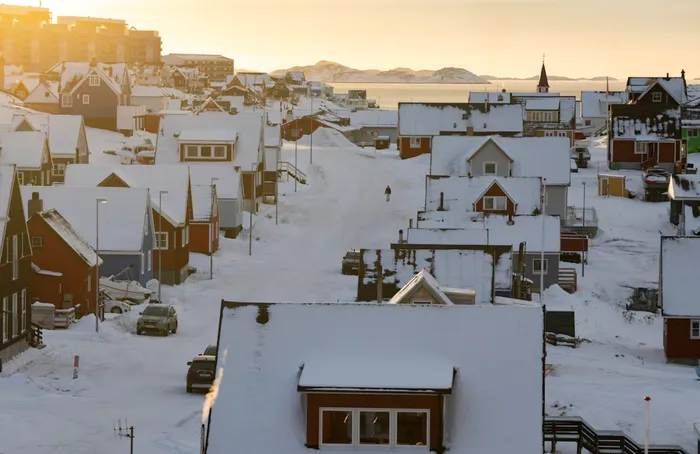
A person walks along a street on the day of the meeting between top U.S. officials and the foreign ministers of Denmark and Greenland, in Nuuk, Greenland, January 14, 2026.
Image: REUTERS/Marko Djurica
EUROPEAN Commission President Ursula von der Leyen drew a line in the sand in the wake of US President Donald Trump’s threat to seize Greenland, saying its sovereignty and territorial integrity were not up for negotiation.
Greenland’s strategic importance has grown sharply as climate change opens Arctic shipping routes, increases access to critical minerals and intensifies great-power rivalry in the High North.
Trump has recently threatened to impose tariffs on eight European countries, including Germany, France and the UK, from next month, unless they support his ambition to take control of the Arctic island.
Trump stated that starting February 1, 2026, the US will levy a 10% tariff on all goods from Denmark, Norway, Sweden, France, Germany, the United Kingdom, the Netherlands, and Finland, with the rate increasing to 25% on June 1, 2026.
He characterised the move as a matter of "Global Peace and Security," claiming that the Danish territory is currently vulnerable to foreign adversaries.
"China and Russia want Greenland, and there is not a thing that Denmark can do about it," Trump said. "They currently have two dogsleds as protection, one added recently."
Speaking at the World Economic Forum in Davos on Tuesday, Von der Leyen framed Greenland not as a peripheral territory, but as a defining test of Europe’s ability to defend its interests, uphold international law and adapt to a rapidly changing global order.
“When it comes to the security of the Arctic region, Europe is fully committed and we share the objectives of the United States in this regard,” she said.
Her remarks linked Greenland directly to Europe’s broader drive for independence, economically, militarily and geopolitically. For Europe, Von der Leyen argued, these shifts demand a firmer and more coordinated response.
She underscored that the European Union shares security objectives in the Arctic with the US, citing Finland — one of NATO’s newest members — selling its first icebreakers to the US as proof that Europe already has Arctic-ready capabilities. But she cautioned that unity among allies is essential.
Von der Leyen warned that the proposed additional tariffs between long-standing partners risk undermining shared security interests.
"The European Union and the United States have agreed to a trade deal last July. And in politics, as in business, a deal is a deal. And when friends shake hands, it must mean something," she said.
"We consider the people of the United States not just our allies, but our friends. And plunging us into a downward spiral would only aid the very adversaries we are both so committed to keeping out of the strategic landscape.
"So our response will be unflinching, united, and proportional. But beyond this, we have to be strategic about how we approach this issue, and this is why we are working on a package to support Arctic security."
Von der Leyen outlined a clear framework for Europe’s approach to Greenland, signalling a more assertive and strategic posture in the Arctic.
The EU also intends to strengthen security partnerships across the region, including with the United Kingdom, Canada, Norway and Iceland, recognising that Arctic stability depends on collective action.
BUSINESS REPORT