

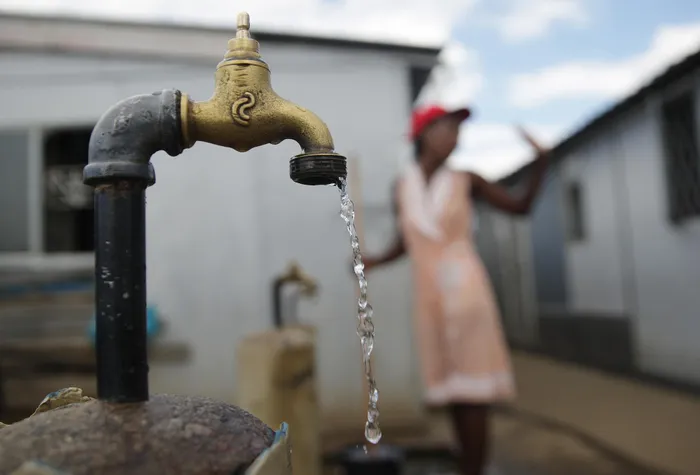
Knysna's water supply is under significant pressure, prompting authorities to urge residents and visitors to conserve water.
Image: Independent Newspapers Archives
SEVERAL water augmentation projects are underway and expected to be operational within the next two weeks in Knysna, currently in the grip of a water crisis.
The Knysna Council on Friday declared the greater Knysna municipal area as a local disaster area in terms of the Disaster Management Act, Act 57 of 2002.
The declaration comes as the town continues to inch closer to Day Zero with an estimated 10-day water buffer if there is no significant rainfall or successful augmentation from alternative sources.
The declaration will allow for much needed national and provincial interventions.
It also allows Knysna mayor Thando Matika to authorise unforeseen and unavoidable expenditure in emergency or exceptional circumstances for which no provision was made in the approved budget.
Matika said the overall coordination of the water-stressed/state of emergency will be dealt with according to the Knysna Municipality Disaster Management Plan.
“The Garden Route District Disaster Management Centre will, in consultation with the Knysna Local Disaster Management Unit, coordinate the short- and medium-term interventions required to address the crises. The Department of Agriculture will also be requested to conduct an urgent assessment report on the agricultural areas within the Knysna municipal area to establish the impact of the drought on this sector.”
The municipality is currently developing a comprehensive water augmentation programme to increase supply, along with provincial and national government partners.
“Specialist teams from the provincial government and the private sector have been conducting geohydrological assessments and engineering studies to ensure interventions are both effective and environmentally responsible,” Matika said.
Augmentation projects underway include developing the Bigai and Bongani springs and refurbishing seven existing boreholes to provide a combined yield of approximately 3,2 megalitres per day. An additional seven new boreholes will be drilled, providing an anticipated yield of an additional 2,7 megalitres per day.
“Additional augmentation projects are currently being investigated,” Matika said.
The total cost of the interventions is estimated at R58 million, underscoring the scale and urgency of the disaster, Matika said.
“Declaring a local disaster not only allows the Mayor to authorise relevant unforeseen and unavoidable expenditure but opens the door to financial assistance from provincial and/or national governments. A funding application was submitted to the Department of Water and Sanitation on January 14, 2026 to cover some of the cost, and final feedback on the outcomes is pending.”
“While we work to implement these initiatives, we must acknowledge that Day Zero is approaching. The only way to postpone, or even avoid Day Zero, is to drastically and immediately reduce water consumption. Only residents can decide how much water they use – it is now literally your choice: reduce water consumption or wait for Day Zero, when everyone will have to queue for a daily personal ration. Day Zero does not mean that Knysna will run out of water, it means that the reticulation system will be shut down to avoid total collapse,” Matika said.
Cape Times