

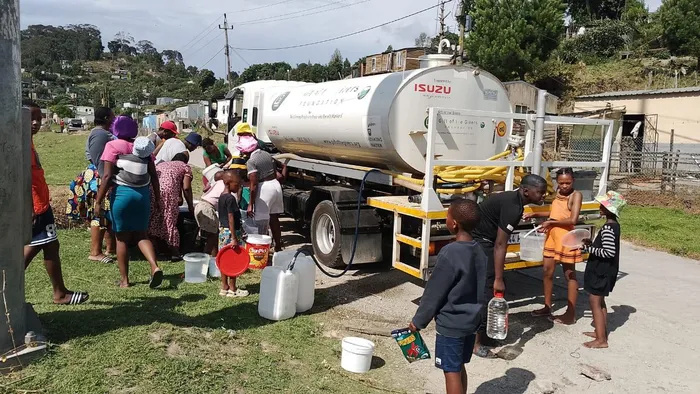
Gift of the Givers has dispatched a team to assist Garden Route residents affected by the heightened water restrictions. The organisation is providing urgent water relief to communities in Khayalethu Valley, Knysna and Zoar, among others.
Image: Supplied
WHILE Knysna residents are heeding the call to drastically reduce water consumption, the town continues to inch closer to Day Zero with an estimated 10-day water buffer if there is no significant rainfall or successful augmentation from alternative sources.
In an update, Local Government, Environmental Affairs and Development Planning MEC Anton Bredell said: “I have been informed that Knysna managed to reduce its water usage from 12 megalitres per day at the beginning of this week to 8 megalitres per day since yesterday. I want to sincerely thank every resident, visitor and business owner who responded to the call to save water.”
He emphasised that these efforts were critical while the Knysna Municipality, with the support of the Provincial Department of Local Government and the National Department of Water and Sanitation, worked together to implement short-term measures to augment the town’s water supply system.
Knysna’s main water source, the Akkerkloof Dam, is currently only 15% full.
“Without significant rainfall or successful augmentation from alternative sources, the town currently has an estimated 10-day water buffer. However, water is still being fed into the system, and with the significant reduction in usage, the water buffer should stabilise and then start to increase, but if water usage continues to surpass inflows, the buffer will decrease,” said the provincial department.
A Joint Operations Committee (JOC) has been established to focus on short-term interventions. These include the development of several springs to feed good quality water into the water network, the refurbishment of seven existing boreholes requiring cleaning and new pumps, the finalisation of an agreement to access 10 boreholes on private land; and securing access to water from a borehole located at the local mosque.
“The significant reduction in water usage achieved over a very short period demonstrates what is possible when a community works together. Continued water-saving efforts remain essential while these emergency measures are implemented,” Bredell said.
Greater Knysna residents are now also paying 100% more on top of their current water bills, as the municipality rolled out harsh new drought tariffs to curb non-essential water.
The implementation of Level 4 water restrictions triggered the application of Stage 3 drought tariffs, in line with the approved Water Services Tariff Policy, the municipality previously explained.
This week, the George Municipality said it implemented Level 3 Emergency Water Tariffs with immediate effect, under the intensified Level 2D Water Demand Management Measures applicable to greater George, Uniondale, and Haarlem, following the continued decline of the Garden Route Dam to 43.48% and the Haarlem Dam to 30.42%.
“The purpose of the Level 3 Emergency Water Tariffs is to discourage excessive water use, protect limited potable water supplies, and ensure that essential water needs can be met during the ongoing drought,” the municipality said.
Also this week, the Mossel Bay municipality said their total available water supply has dropped to between 60% and 50%.
A number of restrictions will apply, including watering of gardens which may only be undertaken for one hour per day between 6pm-7pm, two days per week. No irrigation systems may be used.
The municipality also noted the identification of areas with high water pressure and/or high water consumption for the installation of pressure reduction and/or flow lowering devices.
The City of Cape Town last week urged all residents, businesses and visitors to immediately reduce water consumption as usage spiked over recent hot days, resulting in dam levels dropping 19% below what was available at the same time last year.
The City’s dam storage levels stood at 69,1%, which will need to sustain water supply until the next seasonal rainfall cycle.
WWF South Africa said South Africa is experiencing a “summer of extremes” with wide-spread fires across the Eastern and Western Cape provinces, water shortages facing towns along the Garden Route, and severe flooding in Limpopo and Mpumalanga.
This “summer of extremes” offers clear real-world examples of the impacts of climate change, the conservation organisation said.
Cape Times