

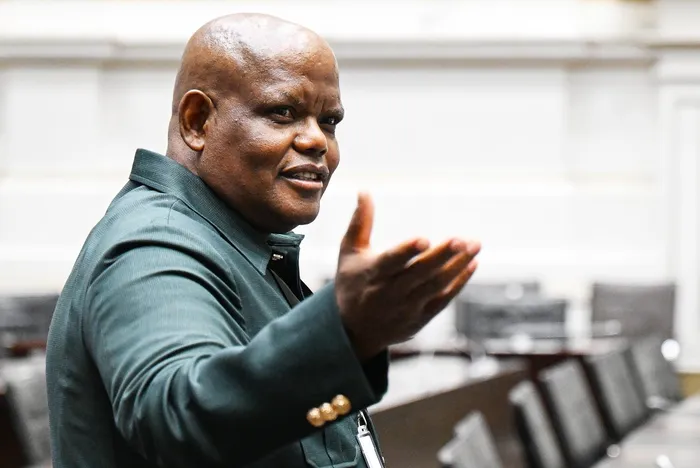
Former acting SAPS national commissioner Khomotso Phahlane at the Ad Hoc Committee that is investigating allegations made by KwaZulu-Natal Police Commissioner Nhlanhla Mkhwanazi.
Image: Phando Jikelo / RSA Parliament
POLITICAL interference in the police became prevalent after the 2007 ANC Polokwane elective conference, says ex-acting police commissioner Khomotso Phahlane.
“From thereon, we started seeing practices that were not a norm,” Phahlane said.
He made the remarks when his evidence was being led by Ad Hoc Committee chief evidence leader Advocate Norman Arendse.
The committee was established to probe allegations made by KwaZulu-Natal Police Commissioner Nhlanhla Mkhwanazi that police minister Senzo Mchunu, who is currently on enforced leave, disbarred the Political Killings Task Team for the benefit of criminal syndicates. Mchunu has denied the allegations.
Phahlane said the appointment of former Crime Intelligence divisional commissioner Richard Mdluli that was followed by former minister Nathi Mthethwa fell outside the established practice.
Phahlane said Mthethwa failed to present the submission on the appointment of Mdluli to Cabinet in 2009.
“I am the last person to be appointed following a submission to Cabinet. Everyone appointed after my time, that process did not follow the Cabinet process,” he said.
Phahlane was the divisional commissioner for human resources at the time of Mdluli’s appointment.
He explained that the protocol at the time was that a recommendation was submitted through the Minister of Public Service and Administration to do the screening and prepare a memorandum for the Cabinet for approval.
“In this case, acting national commissioner Tim Williams called me in and I had to sit together with the minister and other ministers, who constituted a panel,” he said, adding that Advocate Madonsela was the only official who was part of the interviewing panel.
Phahlane said a memorandum was put together, submitted to Mthethwa, and went to the Department of Public Service and Administration a day before Cabinet.
“On the morning of the Cabinet sitting, I got a call from the office of the minister that the submission is to be returned so that appointment can be made and that there was no need for it to go to Cabinet.”
Asked whether Mdluli was qualified for the position, Phahlane said he did not have a problem with Mdluli.
“I present facts as to what the situation was before and what it is now. Even in my affidavit I say there is nothing wrong with General Mdluli. He was one of competent investigating officers,” he said.
Phahlane said the process to appoint deputy commissioner for Crime Intelligence was changed.
He explained that the SAPS national commissioner advertises the post, then appoints an interviewing panel, which makes recommendation and forwarded it to DPSA through the Minister of Police and signed off to go to Cabinet and appointment is made.
“I am not going to dwell on whether it was irregular or unlawful. In the police, the people appointed by the president are the national commissioner and the head of the Hawks.
“There is no provision for the minister to put together or chair a panel, worse in this case, you did not have a national commissioner.”
Mthethwa served as the Minister of Police from May 11, 2009, until May 25, 2014.
He was found dead outside a hotel in Paris in France where he was serving as South Africa's ambassador.
A week before his death, he was accused at the Madlanga Commission of interfering in police matters during his time as minister.
Mkhwanazi told the judicial commission of inquiry into criminality, political interference, and corruption in the criminal justice system, chaired by retired Constitutional Court Justice Mbuyiseli Madlanga, that Mthethwa wanted to stop Mdluli's prosecution and disciplinary case.
"If you talk about political interference, that was the worst that I ever experienced. At that time, I came from the specialised operations; the only thing I knew was to chase criminals," Mkhwanazi had told the commission.
Mkhwanazi also told Parliament’s ad hoc committee that Crime Intelligence had secretly built a R600 000 wall at Mthethwa’s home in KwaMbonambi in KwaZulu-Natal. The family has since disputed the allegations saying Mthethwa and his now widow Philisiwe Buthelezi paid for every single brick of the perimeter wall at his home.
Cape Times