

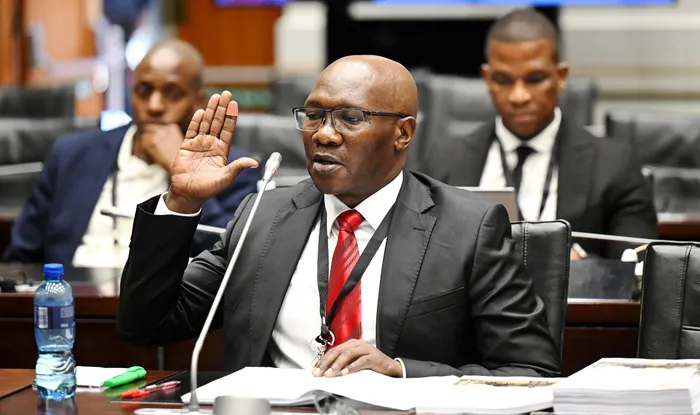
Crime Intelligence head Dumisani Khumalo taking oath before giving his evidence before the Ad Hoc Committee.
Image: Phando Jikelo / RSA Parliament
THE national police commissioner, not the police minister, appoints and discontinues a task team, according to head of Crime Intelligence Dumisani Khumalo.
He made the statement when testifying before the Ad Hoc Committee into police minister Senzo Mchunu’s disbandment of the Political Killing Task Team (PKTT), the moratorium in the filling of vacancies in the Crime Intelligence Unit, and the alleged corrupt relationship between senior leadership of SAPS and members of the public, as well as political interference in the work of the police service.
“It is the prerogative of the national commissioner anytime there is a threat that needs a task team approach, different from normal day-day police approach, to establish a task team,” said Khumalo.
Mchunu served National police commissioner Fannie Masemola with a directive to disband the PKTT with immediate effect on December 31, 2024, and the freezing of vacant positions at Crime Intelligence.
Khumalo said the PKTT was established during 2018 when political killings were rife in KwaZulu-Natal.
“It was through the appointment of the Inter-Ministerial-Committee (IMC) by the President, which was chaired by the Minister of Police,” he said.
He dismissed the suggestion that the PKTT was formed as a result of the Moerane Commission of Inquiry.
Khumalo added that the IMC had found PKTT already in place, but on assessing its performance, they realised it was not properly coordinated.
“It had no prosecution strategy. Going through the minutes of the first two meetings, there is a lot of evidence that talk to that.”
Khumalo said on his deployment to the PKTT to assist Mkhwanazi when he was acting provincial commissioner, his main purpose was to coordinate operations in KwaZulu-Natal.
“The national commissioner approached me to assist because of my coordination role that I play at national level. It was going to be quicker and easier to come with coordinated plan for the reconfigured PKTT,” he said.
He also said the IMC was playing that missing strategic direction and overseeing PKTT activities.
“Under the IMC there was a national steering committee made up of departments led at IMC level and provincial steering committee co-chaired by commissioner and Director of Public Prosecution in KwaZulu-Natal. The purpose of the steering committees at different levels was to make resources available for realisation of objectives of PKTT.”
Khumalo confirmed that there was uncertainty as to the existence and oversight power of IMC after Mchunu issued the directive in December 2024.
However, he said there was no resolution to disband the PKTT, but rather it should continue.
The IMC last met in September 2023 and last had a briefing with President Cyril Ramaphosa in March 2024.
He confirmed Acting Police Minister Firoz Cachalia has not convened a meeting of the IMC since he was appointed.
“We have not received any invitation to brief the IMC since September 2023.”
Asked whether task teams should have indefinite lifespan, Khumalo said they ought to have a timeline because they were established for a particular reason.
“They are supposed to be disestablished after the problem has been dealt with. Looking at the methodology employed by the PKTT, my personal view is for SAPS to make use of the opportunity to change their policing model when it comes to investigations and use the task team model as a transition phase to the correct and proper methodology of investigation,” he said.
Cape Times