

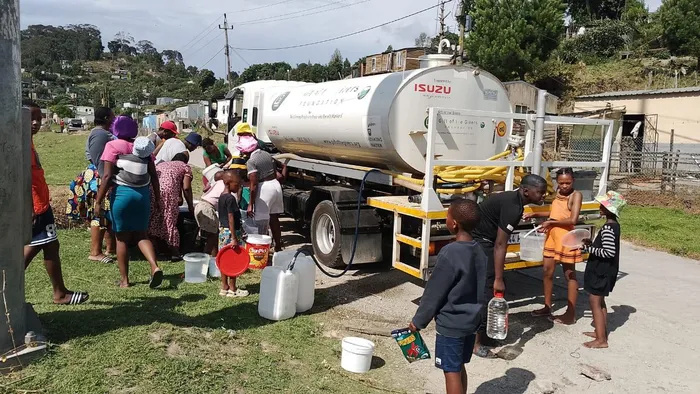
Gift of the Givers is providing urgent water relief to communities in Knysna and surrounds.
Image: Supplied
GREATER Knysna residents will now pay 100% more on top of their current water bills, as the municipality rolls out harsh new drought tariffs to curb non-essential water use during the severe shortage.
“The implementation of Level 4 water restrictions triggers the application of Stage 3 drought tariffs, in line with the approved Water Services Tariff Policy. These tariffs are designed as a demand-management tool to discourage excessive and non-essential water use during periods of severe water scarcity,” said Knysna municipality spokesperson, Nwabisa Pondoyi.
According to the Medium Term Revenue and Expenditure Framework, stage 3 for the 2025/26 period, means an additional 100% of the approved water consumption tariff will be applied, “only if Akkerkloof Dam is at 30% or the river flow is at 200 litres per second and when consumption is more than 25kl per month. The increase will be implemented from 25kl consumption up”.
Residential customers will pay R46.52 per kilolitre for water consumption between 25 kL and 40 kL, the tariff document states.
The Joint Operations Committee—including the National Department of Water and Sanitation, Western Cape Department of Local Government, Knysna Municipality, Breede Olifants Catchment Management Agency (BOCMA) and the Garden Route District Municipality, this week said that the measures were necessary as the Akkerkloof Dam, the main water supply, was down to 20%, giving the town only about 13 days of water.
Local Government MEC, Anton Bredell on Thursday said: “Water security remains a concern for several municipalities, particularly Langeberg, Bitou and Knysna in the Garden Route District.
“In Knysna, the current water supply provides an estimated buffer of 13 days should no additional inflows enter the system. This estimate is based on the Akkerkloof Dam’s current level of 20%. The Glebe Dam is currently 70% full and can provide an additional buffer should there be no rainfall in the catchments of the Knysna and Gouna rivers. The 13 days estimate also does not yet take into account other water sources that can be accessed or additional operational adjustments that can be made to the water supply system.”
He said alternative water sources, including boreholes and springs, have been identified and are in the process of being connected to the municipal water supply network.
"In extreme circumstances, water supply may be throttled in certain zones. The municipality will also install water tanks in higher-lying areas where water pressure may drop. The Garden Route District Municipality and the Department of Local Government have potable water tankers on standby to respond in the event of an emergency. In all the municipalities it is critically important that residents and visitors adhere to the current water restrictions in place,” Bredell said.
Sedgefield Ratepayers Association (SRA) chairperson, Kevin Barnes, said: "We have sufficient water, but lack infrastructure in the form of pumps, pipes and holding capacity".
In a letter to the MEC and municipality, the SRA said they took issue with Sedgefield being included in these restrictions despite the area’s water quantity being stable and sufficient.
“We support sustainable water management and understand the complexities involved, but the present approach does not align with the realities in Sedgefield. We fully recognise the broader regional challenges and support any measures needed to stabilise the system. However, declaring uniform Level 4 restrictions across the entire Greater Knysna area penalises communities like Sedgefield who have sufficient water availability but are still experiencing unacceptable water quality issues. To place residents and businesses under severe consumption limits (6kl per month for domestic use and 50% reductions for business) while the quality of the supplied water remains below expectation is neither equitable nor reasonable.”
The Gift of the Givers has warned of “critical times ahead”
Mario Ferreira, regional coordinator, said: “Looking at the current situation, it's counting the days to day zero in Knysna. Our water tankers are still operational not only in the Knysna area but also in the Sedgefield area. We’ve been helping in Brenton, which is part of the Knysna municipality and in the Kannaland area at Zoar. At this stage, we are here to stay.”
Cape Times