

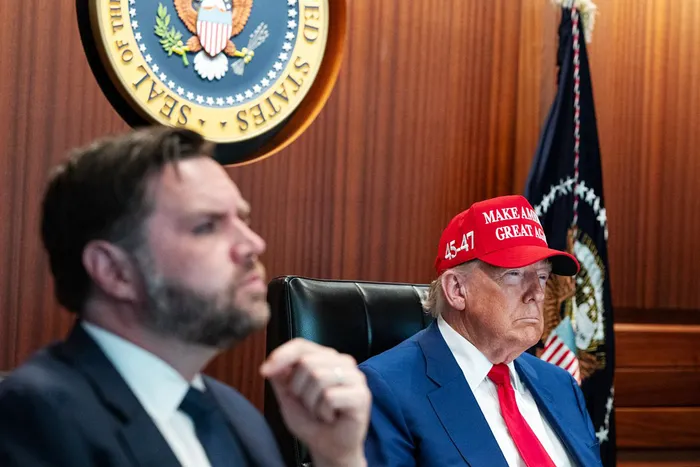
Experts say US President Donald Trump's decision to withdraw from 66 international organisations shows that the US's interests are taking precedence over institutions and rules.
Image: WHITE HOUSE / AFP
US PRESIDENT Donald Trump’s decision to withdraw from 66 international organisations is yet another attempt to influence other nations’ policies and actions through economic, military and institutional power, by exploiting vulnerabilities and controlling critical resources.
This is according to political analyst Professor Theo Neethling, who argues that this decision also reflects another shift away from multilateralism in favour of unilateral power projection under the Trump administration.
Trump recently announced that his administration has withdrawn from 66 international organisations to prioritise "America First" interests.
The organisations include key climate treaties, health bodies and a UN body that promotes gender equality and women’s empowerment.
The move, which could affect nations from Latin America, Europe, Asia and Africa, includes United Nations (UN) and non-UN commissions.
Those directly impacting Africa include the Office of the Special Advisor on Africa, the UN Economic Commission for Africa and the Permanent Forum on People of African Descent.
Neethling said the decision means that the international rules established after World War II would be eroded even further.
"The consequences, as far as international politics are concerned, are profound. Multilateral institutions will be further weakened, and not only financially. And remember the US is already in serious financial trouble, but international organisations will be further financially troubled,” said Neethling.
International relations expert, Professor John Stremlau, described Trump as someone who believes in a world where those with superior power, whether through physical strength, military force, or wealth, have the authority to determine what is moral, just, or legal.
“And that is certainly not the way to go for the future,” he said.
Political analyst and governance expert, Sandile Swana, said the US wants the freedom to act outside national laws, meaning they want to decide what becomes right and lawful to themselves, regardless of whether they are dealing with another nation.
“They don’t want constraints on their sovereignty. They don’t want equity and equality, and they don’t want diversity and equality among nations,” said Swana, adding that the idea of multilateralism, the global order and the UN has to be championed by other nations, including the European Union, the African Union and the Latin American states.
Cape Times