

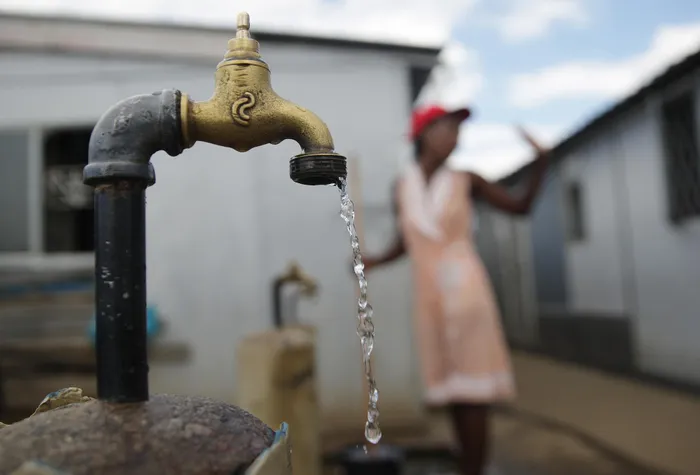
Knysna's water supply is under significant pressure, prompting authorities to urge residents and visitors to conserve water.
Image: Independent Newspapers Archives
WITH just 13 days left of water from its main dam at current consumption levels, the Knysna municipality has started issuing letters to its top 100 water users urging them to cut, or face the consequences.
The Joint Operations Committee (JOC) including the Western Cape Department of Local Government, Knysna Municipality, the Breede–Olifants Catchment Management Agency (BOCMA), the Garden Route District Municipality, and the National Department of Water and Sanitation (DWS) convened on Wednesday amid Greater Knysna’s ‘dire’ water situation.
The JOC said while the Balancing Dam is currently at approximately 90%, it did not compensate for the rapid depletion of Akkerkloof Dam, which remained the primary source of water for the system.
Knysna Executive Mayor, Thando Matika, said: “With no meaningful rainfall in sight and only about 13 days of water remaining in the system from Akkerkloof Dam, this is no longer a warning, it is a crisis. Community cooperation is no longer optional; it is absolutely critical.”
Local Government MEC Anton Bredell, said while all spheres of government have intensified interventions, “without an immediate and sustained reduction in water use, these efforts will not be enough”.
“Water security is a shared responsibility, and every resident, business, and visitor must act now to help protect the limited supply that remains,” he said.
In response to the crisis, the JOC has intensified measures with stricter enforcement of Level 4 water restrictions, alongside enhanced monitoring of high-volume and non-compliant users, among others.
“Ongoing zero rainfall, extremely low river flows, and sustained high consumption levels mean that the current situation is unsustainable without immediate demand reduction. The JOC agreed that alternative water sources must be urgently pursued and that water users are strongly encouraged to make use of alternative supplies, where feasible, to reduce pressure on surface water sources.”
Approached for comment on whether Knysna municipality would be implementing emergency water tariffs, as well as who the top 10 water users were, the municipality said they would respond in due course.
South African Weather Service (Saws) forecaster, Amukelani Mkhari there was a slight chance of rain tomorrow morning through to midday, associated with a cold front approaching from the west and expected to make landfall.
“Light showers are also possible on Sunday evening, extending into Monday morning, with rainfall amounts expected to remain low, mainly light drizzle or brief showers rather than sustained rain. From Tuesday morning onwards, rainfall is expected again, with further rain forecast on Wednesday, Thursday, and Friday, during which totals of around 20 mm may be recorded. Morning clouds or mist may occur at times, especially ahead of frontal systems. Forecast confidence is moderate, with no flooding expected at this stage,” Mkhari said.
UNISA professor Richard Meissner, an expert on water management politics, said: “This is nature in action, a recurring reality across South Africa that varies over time and place. But that doesn’t mean it can’t be mitigated. Because we have a history of water management tied to recurring droughts, we have the ”memory” of such natural events.
"Experience should help one to forecast, to a certain extent, the occurrence of a drought. This means that contingency plans should be in place, along with monitoring rainfall forecasts, which the South African Weather Service and research institutions, such as the Global Change Institute at the University of the Witwatersrand, do.
“Secondly, water conservation in drought-prone areas should become a constant practice, not only when regions face low dam levels, but also when sufficient rainfall occurs. Consumers should be made aware of the value of water and also be informed of weather forecasts. This is a lesson we learned during Cape Town’s Day Zero situation.”
Cape Times