

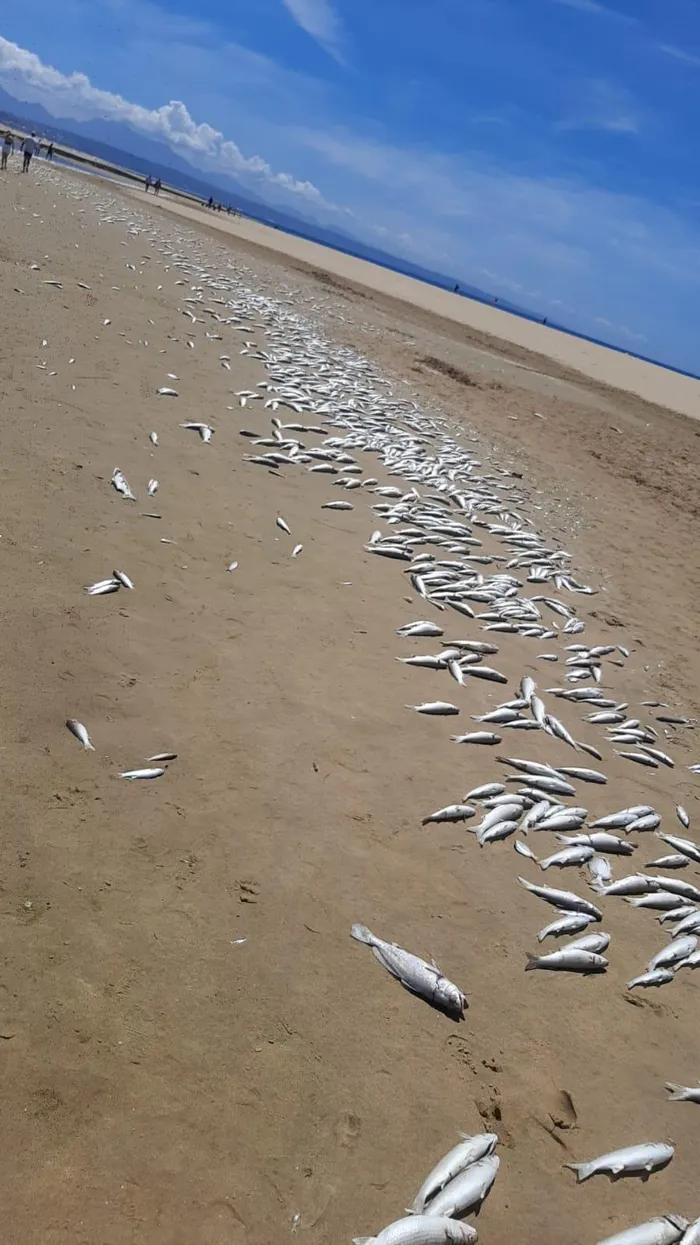
The Mossel Bay municipality says the fish kill resulted from severe oxygen depletion within the estuary.
Image: Mossel Bay municipality
Following engagements with the Mossel Bay Municipality, the Department of Forestry, Fisheries and the Environment (DFFE) says the mass fish mortality observed in the Hartenbos Estuary can be attributed to a combination of interacting factors, but was not due to sewerage.
The Department on Sunday had said the mass mortality was not due to a red-tide, but was the result of sewerage discharge and resultant eutrophication and ammonia toxicity.
In a statement on Wednesday, the department walked back these comments, saying through engagements with the Mossel Bay Municipality, it has been determined that this particular incident can be attributed to a combination of interacting factors, including, but not limited to:
“These are some of the conditions that lead to eutrophication and ammonia toxicity, which the recently released National Biodiversity Assessment and earlier studies highlight as key contributors to fish mortalities in South African estuaries – especially in smaller and temporarily closed systems, such as Hartenbos,” the department said.
It cautioned members of the public against handling or consuming any washed-up marine organisms.
“Such organisms may pose serious health risks and are not safe for consumption, regardless of the suspected cause of mortality.”
The DFFE’s Water Quality Monitors, with other relevant local authorities and stakeholders, have since confirmed that the oxygen levels in the water have normalised and the situation is under control.
Cape Times