
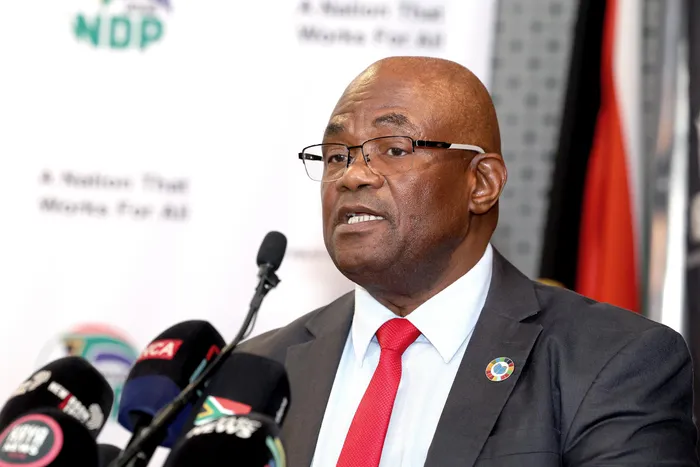
NSFAS Board Chairperson, Dr Mugwena Maluleke during a media briefing to outline NSFAS’s preparations for the 2026 academic year, with a focus on funding disbursements and registration support for all universities and TVET colleges.
Image: Kopano Tlape/GCIS
The National Student Financial Aid Scheme (NSFAS) has reassured students set to receive financial support in the 2026 academic year that upfront payment will be made on February 1 to prevent them from being stranded at universities and TVET colleges.
Addressing the media in Pretoria, NSFAS Board Chairperson, Dr Mugwena Maluleke, said the payment will cover the full book allowance, one month of meals, accommodation, personal care, and travel allowances.
Maluleke said the entity is geared up for the 2026 academic year, with a focus on timely funding disbursements and registration support for universities and TVET colleges.
According to him, NSFAS has met its commitment to process all 2026 funding applications before the academic year starts, with a record 893,847 applications received.
“Of these, 593,981 applications (66.45%) were submitted by female applicants, reflecting the ongoing trend of strong female participation in tertiary education. Male applicants accounted for 299,866 applications (33.55%),” he said.
Maluleke revealed that a significant portion of applications were from vulnerable groups, with a total of 520,545 received from SASSA beneficiaries, while 2,551 applications were from students with disabilities.
“To date, 609,653 applications have been approved, with 203,731 applications currently in progress, and 16,862 applications have been cancelled,” he said.
At least 49,568 have been rejected after rigorous review revealed that the applicants' household income exceeded the R350,000 per annum threshold.
Disgruntled applicants whose applications were rejected can lodge appeals through a streamlined process established for the 2026 academic year.
Maluleke said: “The appeals window opens immediately as application outcomes are communicated, with the final deadline for appeals set for 14 January 2026. Outcomes will be communicated by 16 February 2026. Students must submit all supporting documentation within 30 days of their outcome notification.”
He noted that a significant majority of the applications were received from first-time entry students, with 766,232 applicants vying for funding, while senior students accounted for 125,157 applications.
“In terms of age distribution, we received 428,632 applications from a range of teenagers, 417,823 from individuals in their twenties, 42,186 from those in their thirties, 4,585 from individuals in their forties, and 621 from applicants aged fifty and above,” he said.
He highlighted that the deadline for updating qualification codes was set for December 10, 2025, with the final submission date on December 15, 2025.
“Universities were advised to ensure that students are not enrolled in expired qualifications, as NSFAS will not fund such enrolments,” he said.
According to him, university-led allowance distribution will be extended through 2026. “Monthly remittance returns must be submitted to NSFAS detailing students paid, types of allowances, and dates of payment. Equally important is that accommodation allowances for students in private accommodation will be paid directly to accredited providers, who must enter into legitimate agreements with student occupants.”
He said NSFAS is introducing a transitional framework aimed at creating a centralised, transparent, and student-focused accommodation system.
“As part of this transition, all accommodation dates — including opening, closing, move-in, and move-out periods — will be intrinsically aligned with the academic calendar to prevent students from being stranded at any point during the academic year.
“We are upgrading the accommodation portal to enable students to apply for accommodation, track their application status, accept offers, and log maintenance issues, all within a single platform," Maluleke said.