

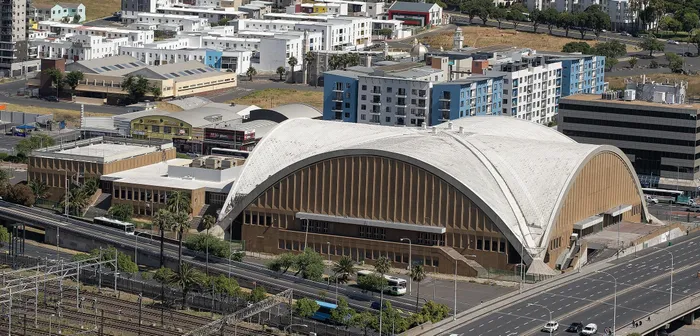
Several significant properties will be included in a major auction of City-owned land parcels, scheduled for 26 February 2026, including the historic Good Hope Centre.
Image: Supplied
Heritage and cultural landmark, the Good Hope Centre is among 50 City-owned land parcels that will go under the hammer in February next year.
The City of Cape Town on Sunday announced that in total, approximately 282 000 m² of land will be put up for auction, comprising 50 parcels zoned for residential, commercial, industrial, community and mixed-use development.
Auctioneer Claremart Group had been appointed to auction the City-owned land parcels, scheduled for February 26, 2026.
“This upcoming auction is an extraordinary opportunity for private-sector investment across the metro. From the Good Hope Centre precinct to commercial and industrial parcels in Mitchells Plain, Atlantis Industrial, Parow, and Goodwood, each site has been carefully packaged to attract capable investors ready to deliver tangible benefits for communities and the broader economy,” said mayoral committee member for Economic Growth, James Vos.
According to Vos, the full list of properties will be made available on the Claremart Group website.
“As part of my mandate, I am prioritising the release of well-located land to unlock economic potential. I firmly believe that our land portfolio must drive economic growth rather than sit idle, and this auction sets the standard for how we will put our properties to productive, purposeful use. To ensure full transparency, bidders will have the opportunity to compete via a public auction,” said Vos.
GOOD councillor, Suzette Little said the Good Hope Centre is not just a property on a balance sheet, it is a heritage and cultural landmark with deep social and historical significance for Cape Town, particularly for working-class communities.
On the auction, Little said there were no clear, public answers on how the proceeds will be used, who will benefit, and how "this aligns with Council-approved commitments to invest in poor and working class communities".
“There has been inadequate public consultation and no convincing heritage-led development plan shared with residents. Selling the Good Hope Centre without a clear, enforceable public-interest outcome risks erasing an important civic space in favour of short-term financial gain,” Little said.
Little said public land is one of the City’s most powerful tools to address housing shortages, spatial inequality, and economic exclusion and once sold, that “leverage is gone permanently”.
“Cape Town has a housing waiting list of more than 400,000 people, many of whom have waited decades. None of the properties identified for sale are being meaningfully considered to reduce that backlog. Selling well-located land, particularly land close to economic opportunities, undermines the City’s stated goal of spatial transformation,” she said.
National Coloured Congress (NCC) councillor Anastatia Davids said the plan would be met with resistance.
“Prime parcels of land rightfully belonging to the coloured people of Cape Town will be sold at a fraction of its market value. There will be no benefit in this transaction for the poor people of Cape Town, instead the beneficiaries of apartheid will look to further enrich themselves at the expense of the inhabitants of the Cape flats. As we struggle with the consequences of living in the most unequal city in the world,” Davids said.
Cape Times