

Golden Mile bursts at the seams: Durban’s beach see massive crowds on Reconciliation Day.
Image: Doctor Ngcobo/Independent Newspapers
PARTLY cloudy and warm-to-cool conditions are expected across much of the country over Christmas and New Year.
The South African Weather Service (SAWS) predicted that it will be a wet holiday season due to the effects of the La Niña weather pattern, which is expected to influence rainfall and temperature patterns across the country.
At a media briefing in Pretoria, senior weather forecaster Jaqueline Modika said the latest seasonal climate outlook for the 2025/26 summer season, covering the period from December 2025 to April 2026 indicates a transition toward a weak La Niña state.
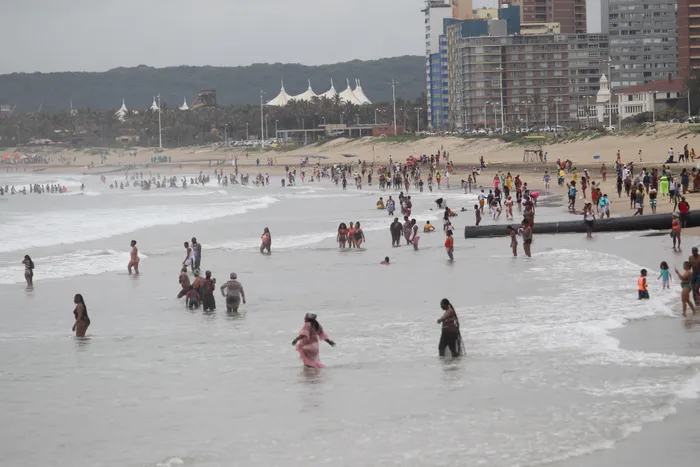
SAWS has issued warning of a rainy weather this festive season as La Niña is expected to bring wet weather.
Image: Doctor Ngcobo / Independent Media
La Niña refers to a climate pattern where the waters in the central and eastern Pacific Ocean become cooler than normal.
“This cooling changes global wind and weather patterns. It typically brings above-normal summer rainfall to the north-eastern parts of South Africa, such as Gauteng, Limpopo, Mpumalanga, KwaZulu-Natal, parts of North West, and Free State,” she said.
She noted that climate models predict above-normal rainfall in central and eastern South Africa, especially in the north-eastern summer rainfall areas.
“These wetter-than-usual conditions are consistent with the typical impacts associated with La Niña episodes and are expected to persist into mid-to-late summer,” she said.
SAWS expects partly cloudy and warm-to-cool conditions over Christmas and New Year.
“Isolated to scattered showers and thundershowers are anticipated mainly over the central and eastern parts of South Africa,” Modika said.
Weather forecasters were asked whether beach-bound holidaymakers will have a washout or enjoy their stay at the sea, given the rainfalls due to La Niña.
Meteorologist Lehlohonolo Thobela said: “I can just say that they can expect some rain over those areas, especially in the east coast into the adjacent interior, like most parts of the eastern half of the Eastern Cape. Most of those areas are yet to experience more rain with all this moisture and more humid conditions. I hope they enjoy it, but they must be safe as they are enjoying it because we have seen what thunderstorms can do.”
He explained that the worry should not only be about the rain, adding that there are possibilities of damaging winds and other weather patterns.
“In the severity of the end of the thunderstorm, we may even have an impact such as a tornado going over the rain. So, it is not only about rain; sometimes, with the temperatures going high and low, people get sick. I think in all the enjoyment, and I know it is festive and we all want to have fun, just be aware of the weather conditions and keep in check. Don’t have fun without looking at the weather,” he said.
The media briefing took place against the backdrop of several severe weather events experienced from mid-to-late spring into the onset of summer.
Modika said: “This includes the heavy rainfall that was recently experienced over the KwaZulu-Natal midlands, resulting in widespread flooding in the uMshwathi municipal area, and leading to tragic loss of life and extensive damage to infrastructure.”
Severe thunderstorms also hit Gauteng, Mpumalanga, and Limpopo, bringing hail, heavy rain, and strong winds. Northern Gauteng and parts of Limpopo took the brunt of the bad weather.
“These incidents rounded off a year marked by profound loss, including the devastating rainfall and flooding in parts of the Eastern Cape, where more than 100 people lost their lives, including residents of rural communities such as Dicoligny near Mthatha,” she said.
Cape Times