

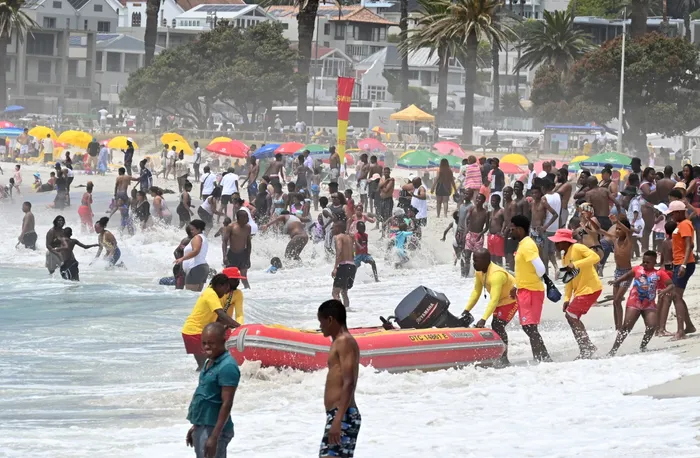
Beachgoers at Camps Bay beach on Tuesday.
Image: Ayanda Ndamane/ Independent Media
A RAW sewage spill contaminating Camps Bay beach resulted in the temporary closure of the site days before hundreds of beachgoers flocked to the popular beach for Reconciliation Day ‘celebrations’.
The City confirmed that the beach was opened on Monday after water sampling was done and clean-up was completed by Saturday.
However the results of the sampling were not made available.
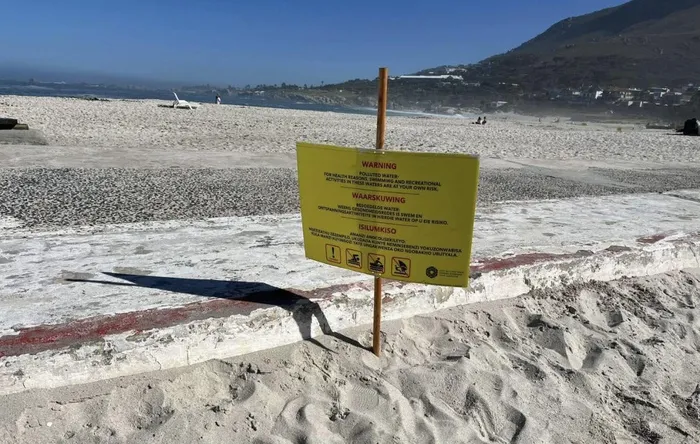
Camps Bay was closed for a period after a sewer spill.
Image: Michael Beaumont
“On the afternoon of Friday, 12 December, the City became aware of a sewer spill in Camps Bay after a rain event. This sewer event is not related to the marine outfall operations but rather is attributed to a local sewer spill. Water and Sanitation teams were activated to investigate the extent of the spill and quickly began sanitation and cleaning operations in the affected areas. While the sewage did not reach the ocean, it did reach a small section of sand," said Water and Sanitation City’s mayco member Zahid Badroodien.
He added that City Health, as a precautionary measure, placed temporary signage on the “affected section of the beach”.
“Water sampling was conducted to ensure safe swimming conditions may continue at this section. The precautionary signage was removed on Monday, 15 December. It is to be noted that during periods of rainfall, sewer systems are sometimes affected, due to the water intrusion,” he said.
The spill comes as ActionSA continues to pile pressure on the City over the marine outfalls in Camps Bay, Green Point and Hout Bay, through which the City discharges untreated sewage into the ocean.
The party recently held a press conference at Camps Bay on the weekend, questioning the City’s environmental licence approvals.
ActionSA national chairperson Michael Beaumont said his party has appealed to the Department of Forestry, Fisheries and the Environment (DFFE) panel, sounding the alarm that despite all of the City’s efforts to cover it up, “Cape Town is on the brink of becoming the next eThekwini”.
“A multi-year sewage crisis has led to the collapse of Durban’s domestic tourism industry, with annual tourist numbers dropping from 15 million in 2015 to just 800 000 in 2023. Its beaches are regularly closed because of high E. coli counts in the water, where people now swim at their own risk. If you think this is far-fetched for Cape Town, let me paint the picture for you. Cape Town pumps an estimated 27 million litres of raw, untreated sewage into its coastline every day through marine outfalls in Camps Bay, Green Point and Hout Bay. Beaches are increasingly being closed when winds blow these floating islands of sewage ashore, and reports of beachgoers getting sick are increasing in frequency,” said Beaumont.
In their submission, objecting to a permit for the outfall at Camps Bay, National Sea Rescue Institute (NSRI) chief executive, Dr Cleeve Robertson noted substantial evidence of the bioaccumulation of toxins in plants and animals in the area which are long-lasting and are not mitigated.
Badroodien said regular coastal water monitoring confirmed that the City’s recreational beaches were safe for recreational use and that coastal water quality was within the acceptable recreational parameters.
“In an attempt to fear-monger amongst our residents and visitors, ActionSA attempts to create a false comparison between our well-run city and the failing city of eThekweni. The truth is that in eThekweni rampant sewage overflows and failing infrastructure have led to the sewage being discharged directly at beaches. The City continues to closely monitor not only our three marine outfalls but our coastal waters along the stretches of beach as well. The outfalls do not impact recreational areas or blue flag beaches and are positioned far from the shoreline where effluent is dispersed within what is termed an ‘allowable mixing zone’.”
He accused ActionSA of intentionally seeking to mislead the public by claiming that the City has applied for new licences.
“This is not the case. The City is working with the Department of Fisheries, Forestry and the Environment (DFFE) to review license conditions that are inconsistent across the three marine outfalls. It is incorrect to claim that the City is discharging an uncontrolled volume of screened sewage into the ocean through the marine outfall.”
DFFE did not respond to requests for comment by deadline.
Cape Times