
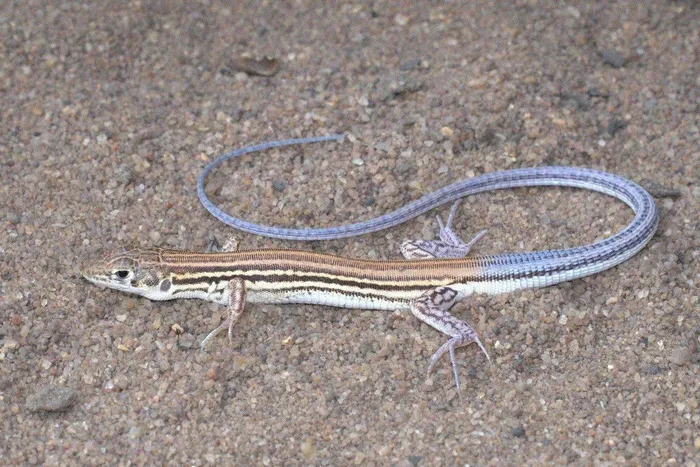
Blue-tailed Sandveld Lizard (Nucras caesicaudata)
Image: Supplied
A remarkable milestone in herpetological research has been achieved with the rediscovery of the Blue-tailed Sandveld Lizard (Nucras caesicaudata), a species that had eluded scientists for more than half a century. This elusive lizard, first described in 1972, has tantalised researchers due to its mystery, vanishing from records since its last sighting more than 53 years ago.
With the Blue-tailed Sandveld Lizard back on the radar, conservationists remain hopeful that ongoing surveys and future research will shed more light on the status of this enigmatic lizard, ensuring that it does not vanish again into obscurity.
The Blue-tailed Sandveld Lizard was originally identified based on specimens collected between 1966 and 1971, primarily around Gonarezhou National Park in south-eastern Zimbabwe and the north-eastern section of the Kruger National Park in South Africa. Additionally, it was found in the Gazaland Plain of central Mozambique. However, as no sightings were verified post-description, the species was relegated to a status of "data deficient" on the IUCN Red List of Threatened Species both in South Africa and on a global scale. Its absence from records led researchers to designate it as a 'lost' species, as sightings had not occurred for over a decade.
In an exciting turn of events, a dedicated team from the Endangered Wildlife Trust (EWT) successfully captured and photographed a Blue-tailed Sandveld Lizard during rapid biodiversity assessments in December 2025. This sighting occurred in Banhine National Park, situated in southern Mozambique, highlighting not only the species' enduring existence but also extending its known range. The conservation-enthusiast team also recorded sightings in Zinave National Park, reflecting a step forward in understanding the species' distribution and habitat requirements.
The rediscovery of this lizard was made possible through collaboration between the EWT and several organisations, including the Administração Nacional das Áreas de Conservação (ANAC), the Maputo Natural History Museum, and the Peace Parks Foundation. Supported by funding from the Government of Canada’s Global Affairs branch, the initiative is part of the ongoing Restoring African Rangelands Project led by Conservation International.
In addition to capturing a specimen, the research team has collected a tissue sample for genetic analysis to better understand the taxonomic placement of the Blue-tailed Sandveld Lizard within its genus. This could offer vital insights into the species’ evolutionary history and ecological requirements.
Earlier surveys conducted in November 2025 also provided promising signs, with a second individual sighted in Zinave National Park, although it eluded capture and documentation. Researchers explained that further investigations into its population dynamics are essential to inform effective conservation strategies.
Cape Times