

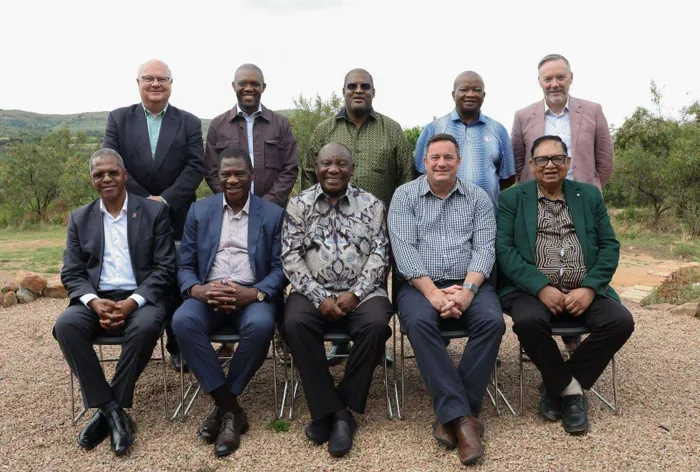
President Cyril Ramaphosa and leaders of the Government of National Unity (GNU) following a two-day retreat at the Cradle of Humankind, pledging to step up efforts to tackle unemployment, poverty, crime and corruption.
Image: GCIS
THE Government of National Unity (GNU) has done little to change public perception about the country’s political leadership, with confidence in its effectiveness remaining relatively low.
This is according to the Institute for Justice and Reconciliation's (IJR), 2025 South African Reconciliation Barometer (SARB), conducted one year into the first term of the GNU.
Data collection took place between July and August, which included face-to-face interviews with 2 006 people throughout the country.
Many South Africans felt that national leaders neither listen to nor act in the interests of ordinary people.
Only a third of participants expressed a “great deal” of confidence in the effectiveness of the GNU.
“Despite the dramatic shift in the national political landscape, survey results revealed a similar picture to 2023 – one characterised by perceptions of distrust, doubt and division. Public opinion remained largely unchanged across many of the Barometer’s dimensions and questions, and in fact worsened in some areas. These included diminished feelings of recognition and respect among people of different languages and cultures, as well as deepening divisions along regional, geographic and socioeconomic lines.”
One explanation could be that “ultimately, many of the parties, leaders and agendas remained the same after the 2024 election”, researchers noted.
The strongest factor shaping confidence in the effectiveness of the GNU was respondents’ province of origin. Average confidence was highest in the Western Cape, North West and Limpopo and lowest in the Northern Cape KwaZulu-Natal and Free State.
Confidence in public institutions also remained low in 2025. Only a third of South Africans were confident in the legal system in general, SAPS or the president (33%). The lowest levels of public confidence, in keeping with 2023 results, were in local government (26%).
According to elections expert and emeritus professor Susan Booysen, the GNU has “tottered from one near-death experience to the next”, from disputes over Cabinet appointments to a contested legislative programme, a rejected national budget and ideological conflicts over foreign-policy positions on the Russia–Ukraine and Israel–Palestine wars.
“Tensions were particularly evident between the two largest parties, the ANC and DA, surrounding the government's legislative programme. The DA opposed the National Health Insurance (NHI) Act and Basic Education Laws Amendment (BELA) Act, both passed in the lead-up to the 2024 elections, as well as the 2025 Expropriation Act,” the report read.
Despite differences in candidates, manifestoes and policy platforms, levels of public confidence in political parties were universally low. Half or more of all South Africans expressed little or no confidence in the ANC (50%), DA (54%), MK (54%) or EFF (53%).
Just over half of respondents believed progress had been made in bringing about reconciliation among citizens.
Most South Africans (73%) strongly agreed that the country still needs reconciliation in 2025. Barriers to reconciliation were poverty and income inequality, the survey found.
“As the results of the 2025 Reconciliation Barometer demonstrate, many of the country’s intransigent challenges have persisted. Public dissatisfaction and distrust have not abated with the establishment of the GNU – at least not yet. In a continuation of the trends of recent survey rounds, many South Africans believed the government is not responsive and changes since 1994 have been limited.”
“It is critical that the GNU and political leadership demonstrate that democracy can deliver meaningful improvements in people’s lives since the end of apartheid. Rebuilding trust in institutions and leadership remains a central priority and survey results suggested will require substantive and visible progress in areas such as government responsiveness and combating corruption.
"Second, addressing profound poverty, unemployment, inequality and economic exclusion remains essential for both reconciliation and democratic stability. The gap between rich and poor remained, according to South Africans, (is) the biggest source of national division and the main barrier to reconciliation.”
Cape Times