

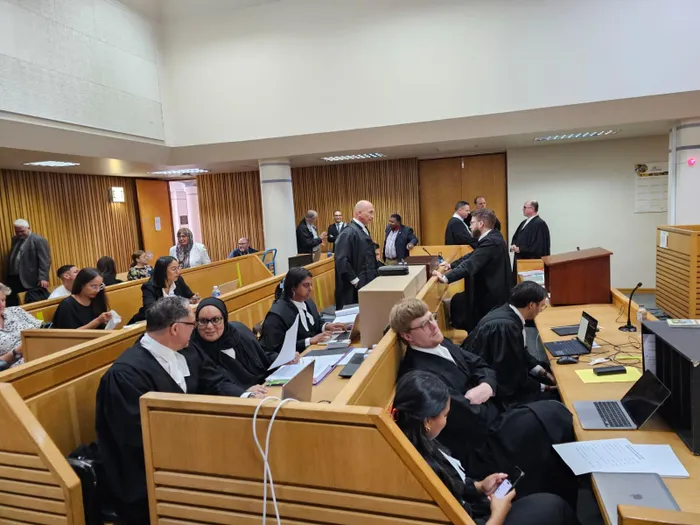
The advocates for the City of Cape Town, SA Property Owners Association, AfriForum, GOOD, Cape Town Ratepayers Association, SA 1st Forum, and Department of Cooperative Governance and Traditional Affairs were present in court.
Image: Theolin Tembo/Independent Newspapers
Should the court rule in favour of the South African Property Owners Association (SAPOA) and AfriForum, the City says they will seek to have Section 75A of the Systems Act declared inconsistent with the Constitution and invalid, as it impedes their ability to exercise their full municipal powers and deliver services to communities.
Proceedings in the fight over the City’s fixed tariffs and their decision to link certain fixed charges to property values continued on Wednesday, where SAPOA and AfriForum responded to the City’s assertion of having “unconstrained power”, and the City also argued its counter-application.
The Department of Cooperative Governance and Traditional Affairs (Cogta) is a respondent in the case.
At the centre of the dispute, being heard by Judge President Nolwazi Mabindla-Boqwana, as well as presiding judges Judge Andre Le Grange and Judge Katharine Savage, SAPOA and AfriForum are challenging the City’s fixed tariffs and their decision to link certain fixed charges to property values.
In its main application, SAPOA is asking for the three tariffs in the budget, namely the Cleaning Tariff, the Fixed Water Charge, and the Fixed Sanitation Charge, to be declared unconstitutional and invalid.
The City has maintained that its fixed charges are not rates but service charges.
Proceedings on Wednesday began with SAPOA and AfriForum responding to the City’s claim from the previous day that it has unconstrained powers, and that there are no restrictions on what it can impose.
AfriForum argued that residents are in a great deal of trouble if the City’s argument of unfettered power is true. They also explained that the City’s argument doesn’t hold water as “one simply cannot divorce the powers of municipal powers from national legislation”.
AfriForum had previously said they understand the City must raise revenue and deliver essential services, but that the “City must always act within its fiscal powers”.
They also tackled the City’s issue of the “best case scenario” of a R1.9bn shortfall.
They said that the argument of how to raise the shortfall will not negate the question of the legality of the matter, as the City has sufficient powers.
“We are saying there should only be one rate, but that they should have the ability to fund everything else through the increase of that rate… We are saying there should not be multiple rates on the same account,” AfriForum’s Advocate Etienne Botha SC said.
He added on the matter of cross-subsiding, “there is nothing wrong with using rates to enable the City to deliver on its Constitutional obligation, whatever it may be”.
On challenging the fixed water tariff, Botha added that the City has the ability to do an audit, go on a property and determine what its water use is.
He said the case is a matter of the principle of legality. “One does not ignore the fact that the City has challenges”, however, “one must not forget what the challenges of the people in the municipality are”.
A large portion of the proceedings also dealt with the City’s counter-application where if the Court favours the applicants’ interpretation that the Systems Act does not lawfully permit these charges, “it seeks a declaratory order that section 75A (read with s74(2)) of the Systems Act is ‘inconsistent with the Constitution’, and ‘unconstitutional and invalid to the extent of its inconsistency’ (together with related relief)”.
In their court papers, the City said their challenge is not raised in reaction to action being taken against the City, but that “it is a consequence of the City’s chosen method of implementing the impugned charges”.
The court heard from the City’s legal representative, Advocate Karrisha Pillay SC, that if the fixed tariffs are scrapped, it would be extremely difficult for the City to recover the shortfall through other revenue sources, such as rates or surcharges.
Pillay further said that without these fixed charges, it will be unable to deliver these services.
If the court rules in favour of AfriForum and SAPOA, they are requesting to have until the end of the 2025/26 financial year in June 2026 to remedy the situation, and also that the court refrain from ordering refunds of revenue already collected.
The case resumes Thursday.
Cape Times