

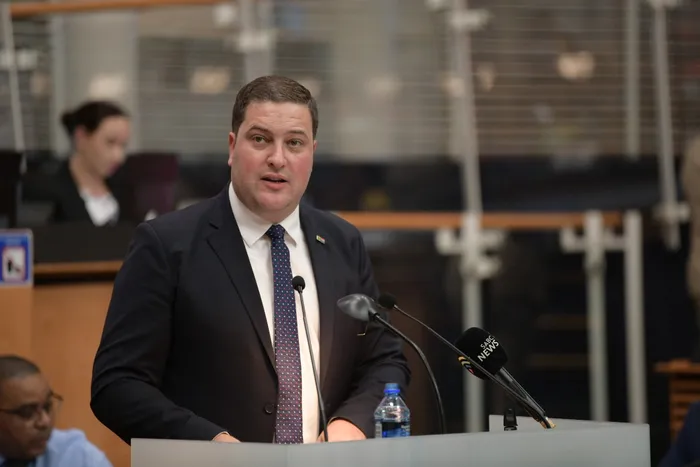
City of Cape Town Mayor Geordin Hill-Lewis
Image: File
THE City’s controversial fixed water, fixed sanitation and city-wide cleaning tariffs will come under judicial scrutiny when the matter comes before the Western Cape High Court on Tuesday.
The South African Property Owners Association (Sapoa) wants these tariffs or the City’s entire 2025/2026 budget, declared unconstitutional.
A number of organisations including government departments have filed papers in support of Sapoa’s court bid. They include the National Department of Cooperative Governance and Traditional Affairs (Cogta), #SA1stForum, GOOD and the Cape Town Collective Residents Association, among others.
Sapoa’s main argument is that the fixed charges contravene the applicable constitutional and national legislative frameworks.
“The fixed charges are not service charges, but they are in fact disguised property rates. The question to be answered is whether it is legally permissible to levy tariffs against property owners for cleaning services based on the value-of their properties, regardless of whether the property owner actually receives such services at the property, or in the area of his or her property.
“Traditionally, due to the fact that sanitation’ sewerage output from a specific property cannot be measured, sanitation’ sewerage charges were calculated as a percentage of the relevant property's water consumption charges. This method of calculation meant that there was some correlation between a property's water use and its sewerage use. There is however, no rational connection between the cost of delivering sanitation services to residents and property value,” the association argues.
Despite widespread public outrage during the comment period of the draft budget, Sapoa said a revised draft budget was eventually passed with only minor changes.
“The City seemingly seeks to justify its approach as its implementation mimics that of foreign cities. This, of course, is hardly a defence to the application, for two wrongs do not make a right, not to mention that precedents of international cities cannot make legal what is otherwise unlawful under South African law.”
However the City argues that spending must be within the parameters of affordability and aligned with service delivery goals.
“The reality is that in each budget there must be trade-offs and compromises as a result of a massive and continued growth in our residents, as well as historical sacrifices that have occurred. The City-wide cleaning service is designed to make an impact in public places that are enjoyed by all, in all neighbourhoods.
“The City's approach to billing non-domestic customers a fixed tariff based on meter size continues is consistent with previous budgets, save that for non-domestic customers a sanitation fixed tariff (also based on water meter size) has now been introduced. Thus, the Budget imposes on non-domestic customers, fixed tariffs for water and sanitation based on water meter size. Should the City be required to reduce its revenue base, it will have to make difficult choices in suspending critical capital infrastructure projects and reduce service delivery standards, including but not limited to cleaning and any other City-wide services,” court papers read.
In its court papers, Cogta said the City had been contemplating the levying of a sanitation charge through the Rates Act since 2018 and, to that end, approached the department to amend the Rates Act to accommodate a further such charge. However, the request was declined.
"Furthermore, since its budget presentation to the Treasury in April 2025, the City has known that the Department (and SAPOA) do not consider that the new fixed cleansing charge may be imposed in terms of the Systems Act. The reference to a 'fixed basic charge' or 'flat charge' in relation to the City’s new water, sanitation cleansing charges is, of course, something of a misnomer. The charges are neither 'flat' nor 'fixed' (in the sense of being unchanging).”
The Department maintains that the City wanted to impose a tax, and hence it was required to have made an application to the National Treasury to request authorisation to introduce a new tax in the municipality’s revenue mix.
Cape Times