

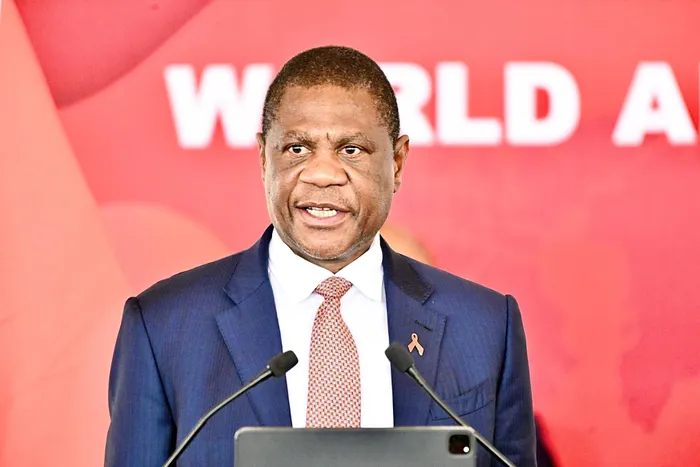
Deputy President Paul Mashatile celebrated the country’s progress in transforming HIV from a death sentence into a condition that can be managed with dignity and hope.
Image: Supplied
THE 1.1 million gap in the country’s HIV response represents mothers who stopped treatment because transport was too costly, men who walked away after negative clinic experiences, young people who feared disclosure, and thousands who moved between provinces without continuity of care.
“It represents the painful truth that success in HIV is never permanent, said Deputy President Paul Mashatile when he addressed a World AIDS Day commemoration at Ga-Masemola Stadium, Sekhukhune District in Limpopo on Monday.
Mashatile, addressed the gathering in his capacity as the chairperson of the South African National AIDS Council (SANAC).
The country continues to carry the highest burden of HIV globally, with an estimated eight million People Living with HIV (PLHIV), and about six million of them on life-saving treatment.
Over 3.5 million people living with HIV in South Africa are virally suppressed, meaning their risk of transmitting HIV to a sexual partner is almost zero.
Some of the initiatives to accelerate the response to HIV in the country include the launch of the 1.1 Million “Close the Gap HIV Treatment Campaign” to accelerate efforts toward achieving the 95-95-95 HIV targets.
The campaign seeks to identify and support the 1.1 million people living with HIV, who know their status but are not yet on treatment.
The country also launched the national rollout of the Six Multi-Month Dispensing (6MMD) programme to enable stable and eligible HIV patients to receive a six-month supply of antiretroviral medication, meaning they will only be required to visit a clinic twice a year.
South Africa's theme for this year, 'Renewed Efforts and Sustainable Commitments to end AIDS', underscores the necessity of revitalising strategies for improved prevention and treatment. The annual commemoration emphasises our critical commitment to accelerating efforts to bring an end to AIDS, said Mashatile.
“It stresses the importance of long-term investment in HIV amid funding cuts and changing global priorities,” Mashatile said.
He added that efforts against HIV and Aids have achieved notable progress, including surpassing the first and third UNAIDS 95-95-95 targets, but stressed how challenges persist in initiating and retaining diagnosed individuals on treatment.
“Currently, South Africa's statistics are at 96-80-97, while global figures stand at 95-85-92.”
He said that to confront the stubborn second 95 target, the country launched one of the most ambitious national recovery efforts on February 25, 2025, known as the 1.1 million “Close the Gap” Treatment Acceleration Campaign.
“This campaign is not merely about reaching a number; it is about restoring life, reclaiming hope, and bringing our people back into a system they drifted away from for many complex reasons.
He said there must be policies that directly address structural inequalities and dismantle stigma, particularly among women and girls, people who use drugs, sex workers, and the LGBTQIA+ community.
“By prioritising equity and inclusion, we can create systems that protect and empower everyone.”
Cape Times