

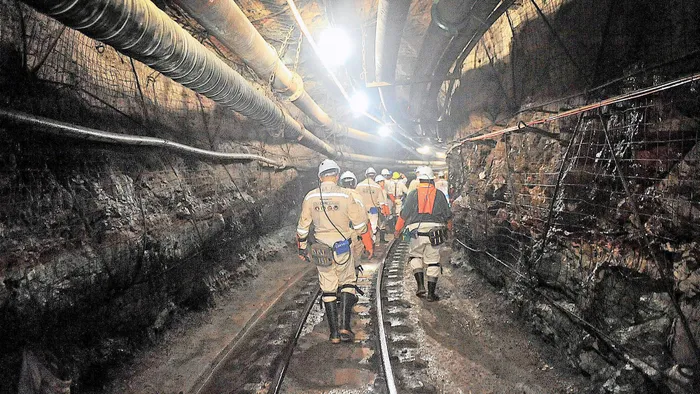
Impala Platinum Mine does not need to disclose the report regarding its own commissioned inquiry into the 2023 tragedy when 16 miners died, the court ordered.
Image: Itumeleng English/ Independent Newspapers
THE Department of Mineral Resources and Energy (DMRE) cannot have access to Impala Platinum Mines’ report into the 2023 disaster that resulted in the deaths of 16 miners and left scores injured when a lift carriage crashed at the bottom of the shaft.
The Johannesburg Labour Court found that the report, commissioned by the mine shortly after the incident, was privileged and that it is not obliged to share this with the Department of Mineral Resources and Energy (DMRE).
The department sought an order compelling Impala to produce the report, arguing that it is necessary for its inquiry under the Mine Health and Safety Act (MHSA) and that it is not protected by privilege.
The department’s inquiry commenced on December 9, 2024 and was adjourned to July this year. When the hearing resumed, an employee of Impala testified and revealed that there was an official investigation done by DRA South Africa Projects, on behalf of the mine. This was the first time that the department became aware of the DRA report.
The presiding officer instructed Impala to disclose the report. Ultimately, Impala refused to do so on the basis that the report was privileged. The inquiry adjourned pending the resolution of the disclosure dispute.
The department subsequently brought an application to compel disclosure of the report. In explaining how it came about that they had commissioned their own investigations, Impala states that shortly after the mine accident, it was aware that there was contemplated litigation in the form of a departmental mine inquiry and a possible prosecution, or civil proceedings, thereafter.
Impala said the mine inquiry may result in the mine being sanctioned or being recommended for prosecution, and it asked for legal advice. Its legal advisors, ENS Attorneys, recommended an expert analysis before it could render any advice.
An executive of ENS stated that the limited function of the DRA was to prepare an expert report for ENS so that it could advise Impala about the impending litigation. A full investigation was done into the cause of the accident, and the mine was provided with the report in February last year.
The department, meanwhile, said that Impala is obliged to provide it with the report, as the DMRE needed it to proceed with its own inquiry, and it thus needed Impala’s report. Impala argues that the presiding officer of the departmental inquiry cannot issue an instruction that it has to hand over the report without obtaining a court order in this regard.
The department contends that the DRA report was brought into existence for the purpose of the investigation, not for the purpose of legal advice in the face of impending litigation. The court noted that under law, legal privilege is recognised as sufficient cause to refuse disclosure of a document. It said the department has not proved that Impala waived the privilege which attaches to the DRA report.
The department argued that fairness and the public interest in having the truth revealed as to the cause of the incident outweighs Impala’s right to invoke legal professional privilege. But the court said, having considered the authorities, it is apparent that legal professional privilege is considered so fundamental that it is absolute, unless waived. “Indeed, legal privilege is more than a mere rule of evidence and is a substantive rule of law,” it said.
The court also pointed out that in the MHSA, there is no provision which limits the right to invoke legal privilege, whether on the basis of fairness or the public interest. "The report is subject to litigation privilege and need not be disclosed,” the court concluded.
Cape Times