

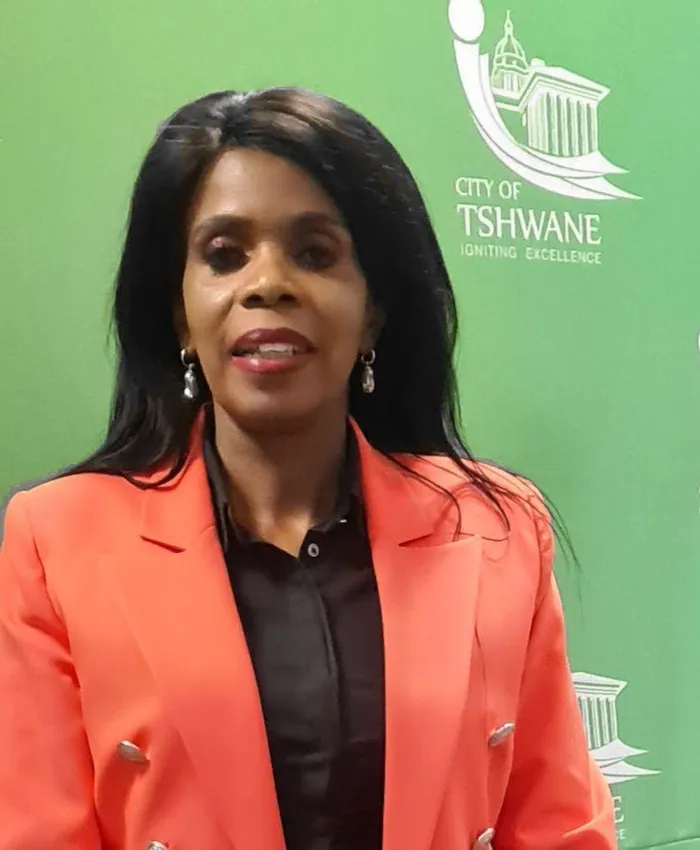
Tshwane's MMC for Economic Development and Spatial Planning, Sarah Mabotsa says a new draft by-law aims to tackle derelict buildings.
Image: Supplied/City of Tshwane
The City of Tshwane will from November 1 kick off a month-long public‑participation process, gathering inputs from stakeholders on the draft Problem Building by‑law, which would allow the metro to ask the courts to appoint administrators to manage abandoned buildings.
Sarah Mabotsa, Tshwane’s MMC for Economic Development & Spatial Planning, said the public‑participation process for the draft by‑law, created by her department, is set from November 1 to December 3, 2025, in all seven city regions.
“With the support of our residents, the implementation and enforcement of this by-law will help to improve the inner city and will create a conducive environment for growth and development in the city,” she said.
She explained that the draft by‑law spells out owners’ responsibilities, duties and liability, including the steps the city can take to declare a building “problem building,” and the remedies for dealing with such properties.
She said building owners must maintain their properties in a good and safe condition and if a property is unlawfully occupied or used for criminal activities, the owner must implement the necessary measures to evict the occupants.
"If waste has been dumped or accumulated on the property, the owner must remove the waste at their own cost. If a building or part of the building or structures on the property has become derelict, the owner must ensure access to the building and/or part of the building is prevented and apply for the necessary demolition permits,”Mabotsa said.
She said if the owner fails to act, the draft by‑law allows the city to ask a court to appoint an administrator for the "problem building or property".
The court‑appointed administrator, she said, may be tasked with collecting rent from property occupiers, and paying the city for supply of electricity, water, sanitation, including rates and taxes due to the municipality.
The administrator may also undertake the maintenance, repair or renovation of the problem building.
Mabotsa said the administrator’s costs will be recovered either through cost‑recovery mechanisms or from the property owner.
She noted that, where cost recovery is unlikely or owners ignore required measures, Section 17 of the draft by‑law allows the municipality to ask the courts to expropriate the property.
“This draft by-law seeks to provide stronger mechanisms to ensure that buildings and properties within the City of Tshwane are safe for occupancy and are not permitted to become centres for criminal activity. The draft by-law also seeks to ensure that the city can recover municipal service costs and other costs through a court-appointed Administrator who may take over the management of problem buildings,” she said.
Councillors from different political parties have welcomed the by‑law with the DA’s Pogiso Mthimunye flagging the need for an institutional mechanism to tackle derelict, problem buildings in Tshwane’s inner city.
ANC councillor Joel Masilela said the by‑law aims to streamline enforcement and foster shared responsibility for property management while the EFF’s Boitumelo Rasweswe called it “critical” for the city’s woes, which includes dilapidated, hijacked, abandoned buildings and unpaid rates.
rapula.moatshe@inl.co.za