

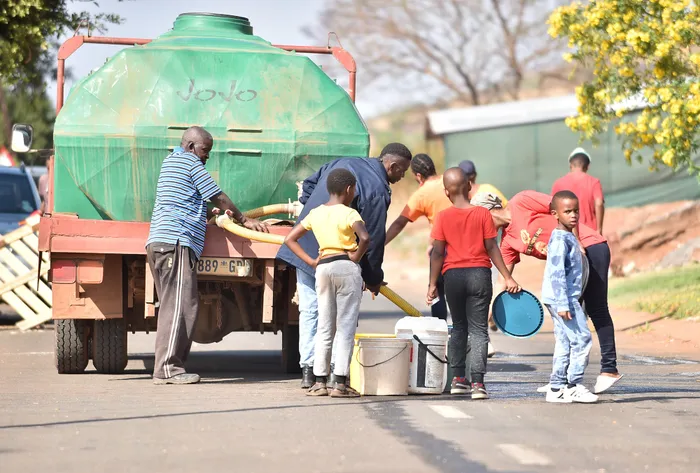
Critics are calling for transparency over City of Tshwane's rapidly escalating water tanker costs, which have ballooned to R777 million.
Image: Thobile Mathonsi / Independent Newspapers
The City of Tshwane has come under fire over the R777 million reportedly spent on water tankers during the financial year ending June 2025 under Mayor Nasiphi Moya's multiparty coalition government.
The spending has sparked concerns as it significantly exceeded the allocated budget by R457 million, with critics raising questions about financial management and accountability.
Bongani Ramontja, leader of the Soil of Africa Civic Movement, has called for immediate transparency and accountability from the city regarding its expenditure on water tanker services.
He demanded that the city “must immediately publish a full breakdown of expenditure on water-tanker services for the last three fiscal years, including number of tankers deployed, volume of water delivered, cost per litre, locations served, and timeline of service contracts”.
He highlighted the stark contrast between the city's spending on water tankers and the lack of access to basic services in disadvantaged areas.
He urged the city to redirect the remaining budget towards installing taps, pipelines, and sanitation infrastructure in these areas.
Ramontja said: “According to a report, Tshwane spends about R450m per year on water tanker services to fill the gap caused by infrastructure breakdown. The municipality’s own documentation shows that from July 2024 to December 2024, the expenditure on water tankers reached approximately R332.3m just for six months.”
Tshwane's DA mayoral candidate Cilliers Brink has also weighed in, calling for a thorough internal investigation into the multimillion-rand water tanker expenditure.
To this end, his party has formally written to Tshwane Municipal Manager Johann Mettler, requesting a comprehensive probe.
“Because of the risk of internal interference in such an investigation, we are also reporting the matter to the Public Protector as a potential form of maladministration,” he said.
Brink said between the 2024 financial year, when Tshwane was governed by a DA-led coalition, and the 2025 financial year, when the city was taken over by a multiparty coalition, water tanker spending increased by 455% from R140m to R777m.
“The emergency supply of water to formalised areas by water tanker trucks is now the single biggest operational expenditure item of the city’s Department of Water and Sanitation. It even surpasses capital spending on pipe replacements,” he said.
The Afrika Mayibuye Movement expressed outrage over the city's excessive spending on water purchases, specifically through water tankers, instead of providing piped water to residents, describing it as a squandering of millions of rand.
In a media statement, the party said: “The artificial water problem has caused the city to exceed its budget by an astonishing R457 million, thereby jeopardising the financial statement during the upcoming audit. Remarkably, in the 2023/24 financial year the city allocated R105 million for tanked water. Such an escalation of R672 million within a span of 12 months is indefensible.”
Mayoral spokesperson, Samkelo Mgobozi, announced that Moya will address the water tanker expenditure issue in a statement on Tuesday morning.
Attempts to reach Finance MMC Eugene Modise for comment were unsuccessful.
rapula.moatshe@inl.co.za