

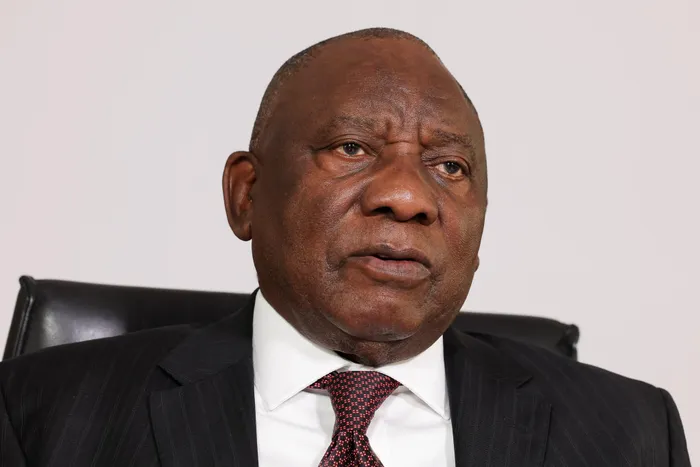
President Cyril Ramaphosa.
Image: Jairus Mmutle / GCIS
President Cyril Ramaphosa's recent statements regarding stronger ties with BRICS nations have sparked a heated discussion in South African politics.
Ramaphosa, speaking at a hybrid BRICS leaders meeting, acknowledged the "seismic shifts in global trade", intensifying global competition and growing geopolitical tensions.
He spoke of "unilateral tariff actions contributing to an increasingly protectionist environment which poses great hardships and danger for the countries of the Global South", directly linking it to negative employment levels and hindered economic growth in South Africa.
He affirmed support for BRICS initiatives to improve economic resilience and strengthen the global multilateral system.
He also stressed the importance of diversifying trade and investment partnerships across Africa, Asia, the Gulf, the Americas, and Europe.
Ramaphosa emphasised South Africa's vision of Africa as "the beating heart of global trade", not merely an exporter of raw materials, and highlighted efforts to consolidate the African Continental Free Trade Area.
He maintained that the multilateral trading system with the World Trade Organization (WTO) and the United Nations at its core must be preserved, while also advocating for reforms within these institutions to address existing imbalances.
Several parties believe that shifting focus from long-standing Western trade partners, especially the United States, may be an insufficient and belated effort to aid the struggling economy.
While the principle of BRICS cooperation is generally welcomed, concerns are mounting over the apparent lack of a coherent long-term strategy and the potential repercussions for South Africa's already fragile economic standing.
The EFF wasted no time in criticising Ramaphosa’s approach, with spokesperson Thembi Msane saying that the EFF took it upon themselves that Ramaphosa and "the so-called Government of National Unity (GNU)" was reacting out of desperation rather than acting from a coherent strategy of national economic security.
She said that South Africa’s historical failure to build a strong industrial foundation, lamenting the country’s continued reliance on a 1960s/70s economic model without the necessary state capacity to drive re-industrialisation.
She added that the EFF had consistently advocated for deeper BRICS engagement, but stressed it should be "as a deliberate strategy for building sovereign industrial and technological capacity", rather than a reactionary move.
The party cautioned that without building local productive capacity, re-industrialising, and using state procurement to create jobs, a shift to BRICS would be "nothing more than a bandage over a structural wound that requires a surgical solution".
The uMkhonto weSizwe Party (MKP), through its spokesperson Nhlamulo Ndhlela, also weighed in, referencing former president Jacob Zuma’s "progressive" tenure as a time when BRICS membership was rightfully prioritised.
Ndhlela spoke about the "impunity of trading with the West", particularly in light of existing loans from Western nations that South Africans have had to endure.
The MKP reiterated its long-standing support for BRICS, particularly for trade and the initiative for a BRICS bank to foster local currency use, declaring it "the best decision to take for the BRICS bloc".
The African Transformation Movement (ATM) echoed the sentiment that the BRICS alignment offers clear benefits, including increased trade, investment, access to technical expertise and funding, enhanced global influence, and improved prospects for local industry and job creation.
ATM spokesperson Zama Ntshona expressed satisfaction with the BRICS approach for its strategic diversification and access to rapidly growing economies, as well as its platform to champion a more equitable global economic and political order.
However, Ntshona did not hold back on criticism regarding the timing, stating: "While the initiative is welcomed, it comes seven years later than expected. The considerable progress that could have been achieved has been hindered by the indecisiveness of the Ramaphosa-led administration."
Ntshona further said that reliance on the US would often be perceived as a geopolitical bully.
Cosatu’s spokesperson Matthew Parks spoke about South Africa’s fragile economy, sluggish growth, and the alarming 42.9% unemployment rate.
Parks voiced concern "by the impact of the US tariff hikes on South African agricultural and manufacturing exports to its market and fear this may see many farm and manufacturing job losses".
He reiterated the critical need for the government to expedite engagements on a new and mutually beneficial trade agreement with the US while they provide support to companies affected by both US tariff hikes and domestic constraints like unaffordable electricity.
mashudu.sadike@inl.co.za