

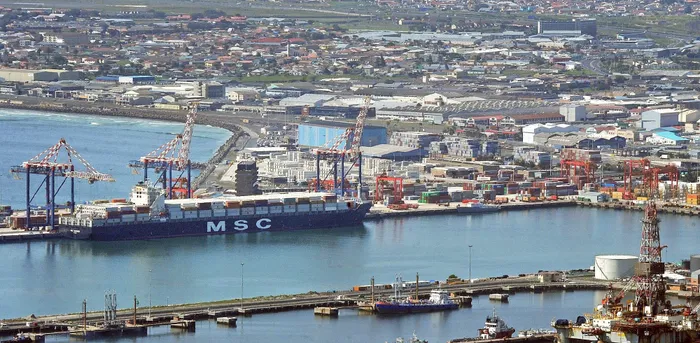
Transnet’s Port Terminals Cape Town is experiencing major backlogs due to windy weather, port congestion, slow ship repairs and outdated equipment. Picture: David Ritchie/African News Agency
CAPE TOWN - It has the potential to contribute even more to the country’s growth domestic product (GDP), create much-needed jobs and stimulate the country’s economic growth.
But windy weather, port congestion struggles, slow ship repairs, and outdated equipment have all had a ripple effect on the efficiency of Transnet’s Cape Town port terminal operation, resulting in major backlogs.
Other major port challenges include berth-depth limitations to vessel sizes.
Last year alone, they had birthing delays of 1 450 hours, while for this financial year there had already been 629 hours lost in terms of berthing delays. Last year, the local terminal also lost 60 days (two months) of productivity due to bad weather-related challenges.
They described the situation in January as scary, because they managed to work productively for only seven days without any interruption.
On average, they are losing about 12 hours a day, while the volumes exported through Cape Town harbour were higher than other regions.
This emerged when the state-owned ports operator briefed the provincial standing committee on finance, economic opportunities and tourism on its operational challenges and progress regarding the Port of Cape Town’s container backlogs.
“We have an installed capacity of 1.4 million TEUs (20-foot equivalent units). However, we are only executing 1 million TEU’s even that we do not meet this, come the financial year-end,” said Cape Town container terminal acting manager Nqobile Ndlovu.
About the days lost he said: “We are sitting at 67 days for the current year already. We know we are in our peak season, and we are competing against the wind. Part of those challenges is that we lost productivity which reduces the export of cargo, which impacts on our economy.”
Transnet National Ports Authority managing executive Phyllis Difeto said the port currently handles up to 330m container vessels versus customer demand to handle up to 351m vessels.
Other challenges also included operational efficiencies and terminal inefficiencies, as well as port congestion due to truck staging limitations, declining volumes and performance, the slow pace of investment in shipping-repair facilities and ageing marine fleet.
Over 47 000 citrus containers were exported through Cape Town terminals.
Peak in terms of volumes was also the peak in terms of wind (which brings the terminal to a complete standstill).
They plan to undertake a number of interventions including night-shift truck utilisation, and have acquired a third mobile crane, six additional haulers, five additional straddle carriers and communicating with at least 1 000 customers via four WhatsApp groups, in terms of forecasts for what they could expect if they were able to plan, among others.
Transnet said it planned to upgrade the Cape Town Container Terminal from manual to a semi-automated operation.
Transnet Freight Rail Belcon inland Container Terminal is strategically located within 24km of the Port of Cape Town, but is currently underutilised.
Questions had also been raised by the committee about the possibility of using the Belcon Station to transport the containers to the Cape Town Container Terminal by train to eradicate a possible backlog.
Transnet said they had engaged with the agricultural industry earlier this month to discuss strategic issues and opportunities to facilitate current agriculture volumes.
However, an ongoing issue that also came up last year was that the terminal only had 100 plug points to serve reefer traffic while 500 plug points were required to meet industry demand for reefer traffic.
According to the Department of Economic Development and Tourism (Dedat), excellent data parcels were kept by various agencies in the port logistics chain, but “are not integrated or used to manage the seasonal peaks that disrupt container cargo flows from loading points to the container terminal, and onto vessels.”
To remedy this challenge they have engaged with Transnet Port Terminals, and the process of synchronisation in the container logistics chain for Cape Town Container Terminal has started.
This will “reduce the backlogs and potential loss of value of cargo content when the terminal becomes congested”.
Dedat’s John Peters said: “Synchronisation is required for a wide range of agencies in the container terminal logistics chain, including exporters, importers, and the terminal and shipping lines. Further data integration is required for the remaining export commodities, as well as for container imports,” he said.
Going forward, they intended to expand the data integration and facilitate synchronisation between planners in warehouses/cold stores, the container terminal and shipping lines.
They also intended to consult with the US Logistics Department on their container terminal model.
Cape Times