

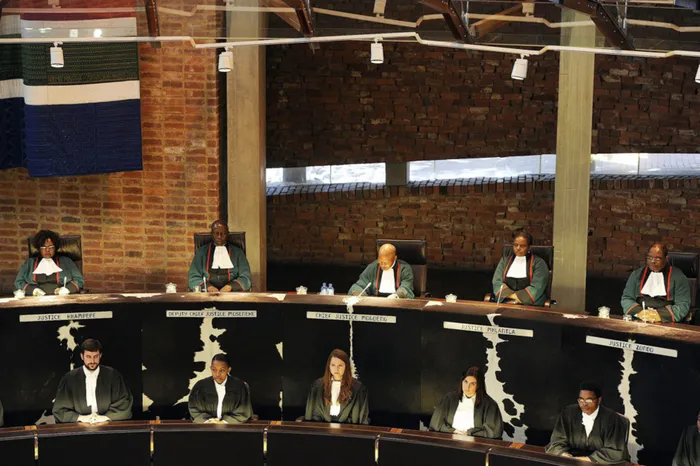
The Constitutional Court File photo: Matthews Baloyi/Independent Media The Constitutional Court File photo: Matthews Baloyi/Independent Media
Johannesburg – The Constitutional Court has heard an application for leave to appeal against a sentence of life imprisonment given to Brendan Ndlovu following his conviction of rape by the Regional Court in Phalaborwa in 2008.
The matter was referred to the highest court when senior litigator Herman Alberts on Thursday argued that there was prejudice in the matter and Ndlovu was not given the correct sentence. Alberts argued that he should be given only 15 years and not life imprisonment.
Ndlovu was charged with rape, however. Although the regional court convicted him “as charged”, it sentenced him to life imprisonment.
However, because the rape involved grievous bodily harm, the regional court concluded he warranted a sentence of life imprisonment.
The court reasoned that the case had been conducted in such a manner that it could not be said that any other information would have changed the outcome.
As a result, the high court decided that Ndlovu’s trial had been fair and dismissed the appeal on October 4, 2011.
The judgment read that Ndlovu accosted the victim while she was on her way home. He assaulted and threatened to kill her.
“She managed to escape but he apprehended and again assaulted her. He assaulted her with his fists, as well as stones and bricks. He forcibly and without her consent had sexual intercourse with her. Naked, and covered in blood, she managed to escape. She sustained open wounds on her head and mouth."
“One of her teeth had to be removed as a consequence of the assault and the evidence was that more of her teeth would be removed in the future,” read the judgment.
Marietjie Jansen van Vuuren, representing the State, argued that the accused had been informed that the minimum-sentence legislation was applicable. He pleaded not guilty to the charge, and he was legally represented throughout the trial.
Jansen van Vuuren further contended that Ndlovu would not have conducted the trial, or his defence, in any other way had he been informed that he faced life imprisonment, and that the trial was fair.
The State had submitted that the incomplete charge sheet was clarified by the evidence of the State witness to include the complainant’s injuries and the fact that grievous bodily harm was inflicted.
“Ndlovu’s trial was fair and he suffered no prejudice,” said Jansen van Vuuren.
Alberts, however, argued that there was prejudice and he was not informed correctly about the allegations.
He argued that Ndlovu was guilty of rape, and that was it. He contended that the charge of grievous bodily harm was not on the charge sheet.
“(This is) not to say the injuries which the victim incurred should be ignored, but there was definitely prejudice. He was misled,” said Alberts.
The Constitutional Court, however, argued that the victim had suffered injuries during the rape, as proved by the evidence.
Justice Sisi Khampepe questioned the point of the inquiry if the high court had ruled on the sentencing.
The Constitutional Court reserved judgment.
@heidigiokos