

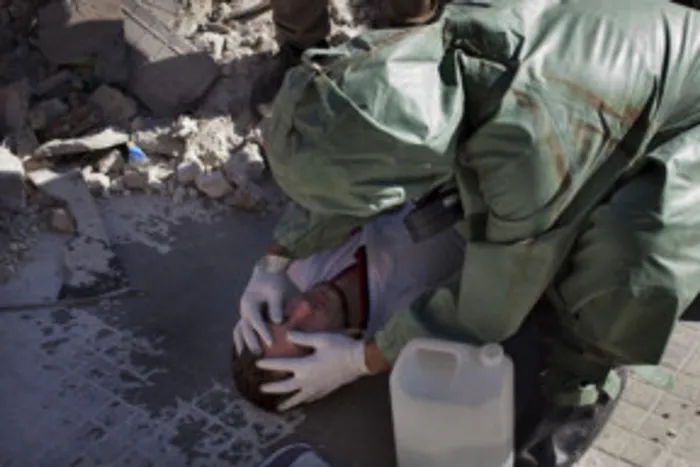
A volunteer checks a man's pupils as he takes part in a simulation of how to respond to a chemical attack, in the northern Syrian city of Aleppo in 2013. For two months, Mohammad Zayed, an Aleppo University student, has been training a group of 26 civilians in the hope they can respond to a chemical attack. File photo: JM Lopez/AFP A volunteer checks a man's pupils as he takes part in a simulation of how to respond to a chemical attack, in the northern Syrian city of Aleppo in 2013. For two months, Mohammad Zayed, an Aleppo University student, has been training a group of 26 civilians in the hope they can respond to a chemical attack. File photo: JM Lopez/AFP
International investigators have said for
the first time that they suspect President Bashar al-Assad and
his brother are responsible for the use of chemical weapons in
the Syrian conflict, according to a document seen by Reuters.
A joint inquiry for the United Nations and global watchdog
the Organisation for the Prohibition of Chemical Weapons (OPCW)
had previously identified only military units and did not name
any commanders or officials.
Now a list has been produced of individuals whom the
investigators have linked to a series of chlorine bomb attacks
in 2014-15 - including Assad, his younger brother Maher and
other high-ranking figures - indicating the decision to use
toxic weapons came from the very top, according to a source
familiar with the inquiry.
The Assads could not be reached for comment but a Syrian
government official said accusations that government forces had
used chemical weapons had "no basis in truth". The government
has repeatedly denied using such weapons during the civil war,
which is almost six years old, saying all the attacks
highlighted by the inquiry were the work of rebels or the
Islamic State militant group.
The list, which has been seen by Reuters but has not been
made public, was based on a combination of evidence compiled by
the U.N.-OPCW team in Syria and information from Western and
regional intelligence agencies, according to the source, who
declined to be identified due to the sensitivity of the issue.
Reuters was unable to independently review the evidence or
to verify it.
The UN-OPCW inquiry - known as the Joint Investigative
Mechanism (JIM) - is led by a panel of three independent
experts, supported by a team of technical and administrative
staff. It is mandated by the UN Security Council to identify
individuals and organisations responsible for chemical attacks
in Syria.
Virginia Gamba, the head of the Joint Investigative
Mechanism, denied any list of individual suspects had yet been
compiled by the inquiry.
"There are no ... identification of individuals being
considered at this time," she told Reuters by email.
The use of chemical weapons is banned under international
law and could constitute a war crime.
While the inquiry has no judicial powers, any naming of
suspects could lead to their prosecution. Syria is not a member
of the International Criminal Court (ICC), but alleged war
crimes could be referred to the court by the Security Council -
although splits among global powers over the war make this a
distant prospect at present.
"The ICC is concerned about any country where crimes are
reported to be committed," a spokesman for the court said when
asked for comment. "Unless Syria accepts the ICC jurisdiction,
the only way that (the) ICC would have jurisdiction over the
situation would be through a referral by the Security Council."
The list seen by Reuters could form the basis for the
inquiry team's investigations this year, according to the
source. It is unclear whether the United Nations or OPCW will
publish the list separately.
The list identifies 15 people "to be scrutinized in relation
to use of CW (chemical weapons) by Syrian Arab Republic Armed
Forces in 2014 and 2015". It does not specify what role they are
suspected of playing, but lists their titles.
It is split into three sections. The first, titled "Inner
Circle President" lists six people including Assad, his brother
who commands the elite 4th Armoured Division, the defence
minister and the head of military intelligence.
The second section names the air force chief as well as four
commanders of air force divisions. They include the heads of the
22nd Air Force Division and the 63rd Helicopter Brigade, units
that the inquiry has previously said dropped chlorine bombs.
The third part of the list - "Other relevant Senior Mil
Personnel" - names two colonels and two major-generals.
Hamish de Bretton-Gordon, an independent specialist in
biological and chemical weapons who monitors Syria, told Reuters
the list reflected the military chain of command.
"The decisions would be made at the highest levels initially
and then delegated down. Hence the first use would need to be
authorised by Assad," said de Bretton-Gordon, a former commander
of British and NATO chemical and biological defence divisions
who frequently visits Syria for professional consultancy work.
The Syrian defence ministry and air force could not be
reached for comment.
Syria joined the international Chemical Weapons Convention
under a U.S.-Russian deal that followed the deaths of hundreds
of civilians in a sarin gas attack in Ghouta on the outskirts of
Damascus in August 2013.
It was the deadliest use of chemicals in global warfare
since the 1988 Halabja massacre at the end of the Iran-Iraq war,
which killed at least 5,000 people in Iraqi Kurdistan.
The Syrian government, which denied its forces were behind
the Ghouta attack, also agreed to hand over its declared
stockpile of 1,300 tonnes of toxic weaponry and dismantle its
chemical weapons programme under international supervision.
The United Nations and OPCW have been investigating whether
Damascus is adhering to its commitments under the agreement,
which averted the threat of US-led military intervention.
The bodies appointed the panel of experts to conduct the
inquiry, and its mandate runs until November. The panel
published a report in October last year which said Syrian
government forces used chemical weapons at least three times in
2014-2015 and that Islamic State used mustard gas in 2015.
The October report identified Syria's 22nd Air Force
Division and 63rd Helicopter Brigade as having dropped chlorine
bombs and said people "with effective control in the military
units ... must be held accountable".
The source familiar with the inquiry said the October report
had clearly established the institutions responsible and that
the next step was to go after the individuals.
Washington on Thursday blacklisted 18 senior Syrian
officials based on the U.N.-OPCW inquiry's October report - some
of whom also appear on the list seen by Reuters - but not Assad
or his brother.
The issue of chemical weapons use in Syria has become a
deeply political one, and the U.N.-OPCW inquiry's allegations of
chlorine bomb attacks by government forces have split the U.N.
Security Council's veto-wielding members.
The United States, Britain and France have called for
sanctions against Syria, while Assad's ally Russia has said the
evidence presented is insufficient to justify such measures.
A Security Council resolution would be required to bring
Assad and other senior Syrian officials before the International
Criminal Court for any possible war crimes prosecution -
something Russia would likely block.