

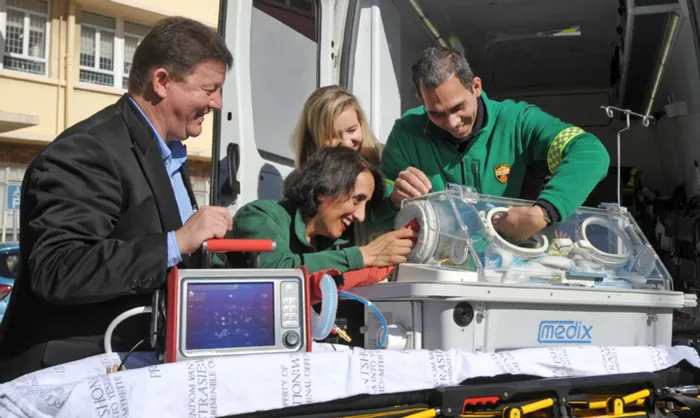
Cape Town - 160707 - Pictured left to right is Pat Basson, Dr. Baljit Cheema, Tammy Sutherns and Grant Felix. The Children's Hospital Trust made a very generous donation of a transport ventilator worth well over R723 000, 00 to the pediatric flying squad, a division of Western Cape Government Health Emergency Medical Services (EMS). The aim of the project is to ensure the safe and effective emergency transport of critically ill babies and children under the age of 13. Reporter: Thandi Whiltshire Picture: David Ritchie Cape Town - 160707 - Pictured left to right is Pat Basson, Dr. Baljit Cheema, Tammy Sutherns and Grant Felix. The Children's Hospital Trust made a very generous donation of a transport ventilator worth well over R723 000, 00 to the pediatric flying squad, a division of Western Cape Government Health Emergency Medical Services (EMS). The aim of the project is to ensure the safe and effective emergency transport of critically ill babies and children under the age of 13. Reporter: Thandi Whiltshire Picture: David Ritchie
THE Children’s Hospital Trust has made breathing easier for children travelling to the Red Cross War Memorial Children’s Hospital. This comes after the trust donated a transport ventilator worth R723 000.
“The Specialised Pediatric Retrieval Including Neonatal Transfer Team will be doing all the sick babies and sick newborns.
“The ventilator is going to be being used by that team. It’s so important because it has the facility to ventilate a baby of 200g in weight.
"We don’t get that low a weight, but we do get babies 700, 800 or 900g and it’s so important to be able to safely ventilate them,” said UCT paediatric emergency specialist Dr Baljit Cheema.
Chief executive for the Children’s Hospital Trust, Louise Driver, said: “ Approximately 31 children are transferred to the Red Cross Children’s Hospital each month. Eighteen of these children are ventilated.
"This new equipment will benefit at least 216 children a year, who are some of the sickest and most unstable patients to visit the hospital."
A study at Oxford University, Washington University and the Imperial College London showed that it took an average of 12.3 hours for children to be transferred from where they were originally presented, to their first admission at the paediatric intensive care unit.
The study also found 43.3% of medical and trauma deaths were unavoidable, 46.7% potentially avoidable, and 10% were avoidable. “There will be two of these machines," Cheema said.
"The trust has provided us not only with the machines, but also with all the consumables that we need." Ventilation would not be invasive, Cheema said.
“We don’t have to go through the windpipe, we can just go through the nose.
“It’s not so traumatic to the baby, you don’t have to give any medicines, and then you can actually ventilate much more safely and you’ve got a lot less potential for harm to the baby's lungs.”