

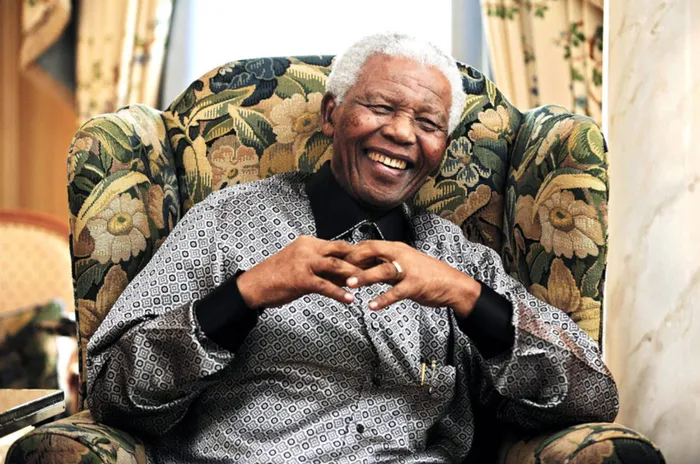
REVERED: The late Nelson Mandela. REVERED: The late Nelson Mandela.
Archbishop Thabo Makgoba delivered an address at the evening prayer service at St George’s Cathedral on the anniversary of the death of Nelson Mandela yesterday. This is an edited version.
We meet today as people of faith, joining with brothers and sisters around the world, to pause and remember Madiba on the second anniversary of his death.
It is fitting that we should do this at the Cathedral because it is here that we, people of faith and of none, have over the past half-century proclaimed a message of justice – from this pulpit, from the platform below and from the steps outside.
Today and for generations to come, Madiba will be revered around the world as an inspirational symbol of peace and forgiveness, but also of the justice on which they must be based. He remains a beacon of hope for all those, everywhere, who are still fighting for their freedom and justice.
On the international stage, the name Nelson Mandela is synonymous with the universal struggle for justice, human rights, freedom and democracy; issues that resonate just as strongly today as they did when he walked free from prison 25 years ago.
Now, I know that Madiba rarely expressed himself in religious terms, or voiced his religious beliefs. But I had the privilege of praying with him regularly during the last years of his life, and from my interaction with him, I have no doubt that all his life, he searched not for perfection, but for union – through other people – with whoever he understood God to be.
He understood that to live a truly good life, you don’t have to be perfect – as he once told an American audience, in response to their adulation: “I am an ordinary human being with weaknesses, some of them fundamental, and I have made many mistakes in my life. I am not a saint, unless you think of a saint as a sinner who keeps on trying.”
Madiba’s memory acts as a powerful and continuing reminder that individuals have the power to make change happen in the world, no matter how mighty the obstacle.
So, how do we celebrate Madiba’s legacy? To some, he was one of the world’s most revered statesmen, who has inspired generations of global citizens through his leadership in the struggle to replace apartheid with a multi-racial democracy. To many, he was the greatest statesman of his era, his leadership steering us through the most difficult time in our history; never compromising his ideals or principles, never pandering to populist demands, always standing up for what he believed in, even against leaders of nations much more powerful than ours.
He will go down in history not just because of the impact he had on South Africans, but on those of countless people around the world. He made a superlative contribution to the global fight for democracy and human rights.
Archbishop Emeritus Desmond Tutu reminds us that when it came to reconciliation, Madiba lived what he preached. He reminds us how Madiba invited his former jailer as a VIP guest to his presidential inauguration. And he invited Percy Yutar, the prosecutor who wanted him jailed for life, to eat with him. He flew to Orania, the last Afrikaner outpost, to have tea with Betsy Verwoerd, the widow of the high priest of apartheid ideology. He was amazing.
As someone who prayed with Madiba, I cannot help but ask myself: If he were alive today, what would he think of South Africa? What would he – who took a 20 percent pay cut soon after becoming president, and who donated much of what he did receive to his children’s fund – think of Nkandla? What would he – who insisted on appearing in court to face a hostile cross-examination, despite advice by his aides that as president he should not – think of a president who has done everything to avoid his day in court?
Times have changed since Madiba played his extraordinary role in helping our society through its transition to democracy. Circumstances have changed, to the degree that we cannot look to what he did and emulate him in order to work through our current challenges. But we can look to the values which underpinned his life and everything he did. So, as we look back, let us take inspiration from his lifelong dedication to instilling the values of Ubuntu, integrity and learning.
May Madiba’s soul rest in peace. May his nearest and dearest be comforted and consoled and may we continue where he has left off, the Lord being our helper. May the example of a fallible individual – not a saint but a hopeful and whole person, a loving person and dare I say a holy man – inspire us to serve God in others and God’s creation until we too are called to God’s rest.
And now, as our Advent hymn heralding the coming of God into the world, has it: “O come, O come, Emmanuel.”