

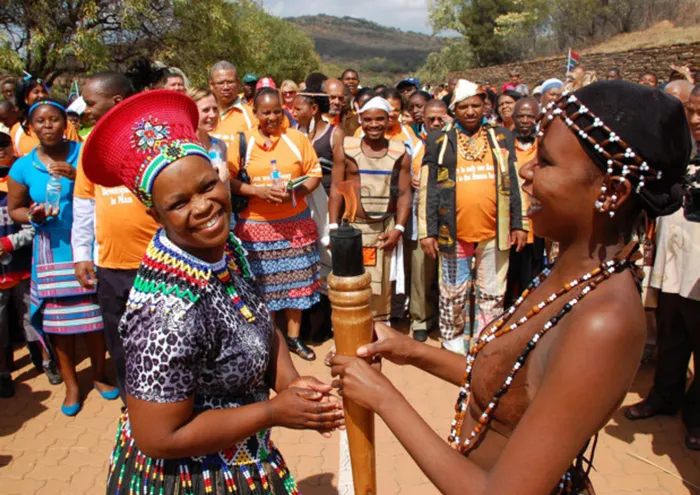
Africa can and should contribute to the world a unique civilisation that is thoroughly spiritual and humanistic, says Joel Netshitenzhe. Africa can and should contribute to the world a unique civilisation that is thoroughly spiritual and humanistic, says Joel Netshitenzhe.
Africa can and should contribute to the world a unique civilisation that is thoroughly spiritual and humanistic, says Joel Netshitenzhe
A hundred and seven years on, the words of Pixley ka Isaka Seme still reverberate in the hallowed chambers of the University of Columbia, summoning Africa and the world to a new way of thinking and a new way of doing things. The erudition of their framing, the profundity of their meaning and the eloquence of the prose – all remind us of the quality of leadership required to lift individual nations and the global community onto a higher state of humaneness.
Should we, of the current generation, feign an understanding of the full meaning of Seme’s injunction, as we continue to revel in pursuits that place the immediate before the long term? Should we celebrate or even critique his notion of “civilisation”, given our preoccupation with the comforts of modern technology to which we prostrate ourselves in the manner of slaves to a deity?
Indeed, can we claim that, in the tradition of Seme and other intellectual giants of his generation, we have continued to view all knowledge as interrelated, across the hyper-specialisation that is today in vogue? Have we not turned the vocation of ordering world affairs and social relations into a narrow profession of a select few; a form of employment that is shorn of sense and sensibility; a huckster’s paradise; and one that spawns social exclusion, inequality, corruption, economic crises, the threats of sovereign defaults and even social conflict and wars?
Since that eloquent exposition on April 5 1906 on The Regeneration of Africa, for which Seme was deservedly awarded the Curtis Medal, the world has experienced oscillations that include the lifting of hundreds of millions of people out of extreme poverty. Technological advances have eased the chores of human existence and opened frontiers from the smallest Higgs boson, the nano-particle, and the human genome, to the limitless mysteries of the wider universe.
Yet in the past two decades, at the same time as the tendency towards economic convergence among nations started to manifest, inequality within nations has been on the increase. As technology was revealing the utility of its magnificence to humanity, its role in the anthropogenic degradation of the environment has been coming out in even bolder relief. In the application of science, the imperatives of commerce have been, in various ways, colliding with humane and ethical conduct. The small-minded urge for political control has started to spawn, on a global and systemic scale, the invasion of that most sacred space, individual privacy.
Humanity will soon pass the 70-year mark without an all-encompassing world war, and yet regional conflicts, civil wars, unilateral invasions and terrorism, which is the deliberate targeting of civilians in armed conflict, have played out in ugly routines to which we are becoming so accustomed as to consider normal. At the same time as the flame of democracy lights up huge expanses of the globe, pockets of “unfreedom”, to paraphrase Amartya Sen, remain; and the formality of the vote in most parts of the world does not necessarily translate into inclusivity in decision-making and deserved public service.
And so, confounded by these contradictions, we dare to ask whether Seme’s vision still bears relevance. “See the triumph of human genius to-day!” he said. “Science has searched out the deep things of nature, surprised the secrets of the most distant stars, disentombed the memorials of everlasting hills, taught the lightning to speak, the vapours to toil and the winds to worship – spanned the sweeping rivers, tunnelled the longest mountain range – made the world a vast whispering gallery, and has brought foreign nations into one civilised family…
“The regeneration of Africa means that a new and unique civilisation is soon to be added to the world... The most essential departure of this new civilisation is that it shall be thoroughly spiritual and humanistic – indeed a regeneration moral and eternal!
“O Africa!… Shine as thy sister lands with equal beam.”
It is against the background of this unmandated extrapolation of Seme’s words that I wish to reflect on the dynamics of Africa’s contemporary socio-political evolution. To what extent is the continent advancing in its utilisation of modern forms of production and exchange? How is its celebrated economic growth benefiting Africa’s people? What is the philosophical underpinning to Africa’s efforts at a renaissance? In what way is Africa benefiting from and in turn contributing to humanity’s endeavours for a better life? And is the African soul able to wander across its hills, plains and valleys unchained from the shackles of political suppression, humiliation and self-doubt?
You will agree with me, that it would be patently dishonest to answer any of these questions in an unqualified affirmative.
Yet we can say with confidence that a new dawn is setting upon Africa. The wound it has borne in colonial invasions, indigenous dictatorships, war and pestilence is steadily but surely healing. Its historical humiliation serves as a spur never again to tolerate the infliction of everything socially retrogressive on her progeny. Its decrepit cities, its huge expanses of arable land lying fallow, its extensive coastline and land mass insufficiently serviced by modern means of transport and communication – all these may be a historical deficit to decry. But equally and more importantly, they are an opportunity for the most rapid investment in infrastructure that the world will ever see in the coming decades.
Indeed, Africa is poised to turn decades and centuries of adversity into opportunity. And this we assert, not out of sheer optimism, but because facts and figures bear this truth out. Since the turn of this century, Africa’s trade with the world has more than tripled; inflation is no longer in double digits; and labour productivity has been rising.
While in the 1980s, average growth in Gross Domestic Product per capita was declining, this has changed to increase at above 2 percent in the past 18 years.
But dare we claim that a humane outcome – “a regeneration moral and eternal” – is the consequence of what these raw data represent? Needless to say, economic growth on its own does not in and of itself portend an improving quality of life for the mass of the people.
One of the abiding lessons of the past two decades is that Africa’s regeneration should find consistent expression in the building of capable and effective states across the continent, combined with quality leadership in all sectors of society and enduring citizen activism.
Thus shall the legitimacy of the African state be enhanced, the better to lead in forging social compacts premised on the sharing of benefit and sacrifice. Thus will Africa’s intellectuals enjoy the space to dream and experiment, as indispensable thought leaders in an unfolding renaissance.
The continent’s natural endowments will then truly become a blessing and not a source of skewed economic growth and social conflict. Democracy will be deepened beyond formalities, to encompass genuine inclusivity – with minorities of whatever hue feeling a genuine sense of belonging.
Economic growth will more effectively benefit Africa’s people, rather than merely supporting the accumulation of a rent-seeking elite and leading to worsening income inequality and the marginalisation of youth and women.
Thus will trade within Africa itself expand, with the hard and soft infrastructure consciously put in place to facilitate this.
These are some of the measures of human progress that underpin Seme’s vision of Africa’s regeneration. It is a vision that has endured in South Africa’s consciousness, as echoed by, among others, former president of the ANC Chief Albert Luthuli and Black Consciousness movement leader Steve Biko, similarly enjoining for a new paradigm in Africa’s thinking and conduct. Let us remind ourselves of their words.
In celebrating the grandeur of Thebes, the ancient capital of Egypt, and the architectural beauty of the pyramids of Ethiopia, and in recalling the “marks of genius and high character” among Africa’s great historical figures, Seme asserts Africa’s historical achievements with pride. In envisioning Africa’s “Congo and her Gambia whitened with commerce, her crowded cities sending forth the hum of business, and all her sons employed in advancing the victories of peace – greater than the spoils of war”, he impels in Africa the courage to dream and to live out that dream.
And in encouraging human contact and mutual benefit on a global scale, Seme goes further to argue that “[n]o race possessing the inherent capacity to survive can resist and remain unaffected by this influence of contact and intercourse, the backward with the advanced. This influence constitutes the very essence of efficient progress and of civilisation.”
Dare we accept Seme’s logic in this regard? Allow me to come out in his defence and make bold to critique his critics.
Contained in his words of lamentation and inspiration, is the conscious acceptance that Africa will be able to progress or to stagnate not because of some ordained exceptionalism, nor in isolation from the rest of the world. Critical to human advancement, and indeed that of Africa, is the ability to extract the best out of the progress that has been made in other parts of the globe; and to embrace that which others have attained which has the potential to lift Africa to an even higher trajectory of growth and development.
Consistent with the extrapolation from his words on the meaning of human civilisation, to which we earlier referred, is the logic that the kind of pride and sense of victimhood that seek to rationalise underdevelopment are, in Seme’s reckoning, a fool’s paradise. A people that does not consciously internalise the humiliation of conquest and stagnation in certain periods of its history, and does not resolve systemically to right that wrong, is not capable of technological advancement.
But beyond the forces of production is the fundamental question of humaneness. Africa can and should contribute to the world a unique civilisation that is “thoroughly spiritual and humanistic”. In Steve Biko’s words, Africa should give the world “a more human face”. If the people of Africa have reason to show impatience, it should be because that potential and that capacity still have to find concrete expression in the continent’s contemporary renaissance and in its contribution to humanity!
How, in this context should Africa relate to the world?
Everywhere across the globe, individual countries and regional blocs are defining and redefining their Africa strategies. Yet Africa has no such strategies in relation to these countries and regions. The renewed interest in the continent is understandable, as the promise of Africa has never been this obvious. And yet contained in this is the danger that Africa will once again become the object of others’ curiosity and the theatre of their geopolitical experiments.
As such, Africa needs urgently to define its geopolitical positioning and posture, which should inform the foreign policies of its various nations. Among the issues that this strategy should address are: how Africa can combine mass absorption of its people into meaningful economic activity at the same time as it modernises and diversifies its economy; how especially sub-Saharan Africa can position itself in these early years of its regeneration as the destination for low-end manufacturing which is relocating from parts of Asia as that continent moves up the manufacturing sophistication ladder; and how Africa should use its natural resources to promote its industrialisation, at the same time as it ensures global security of supply of these endowments.
Similarly, Africa should utilise its burgeoning relations with Asia and the Middle East – which are part of historical geo-strategic normalisation – to extract maximum benefit for its people; and in the course of this, ensure that erstwhile relations of colonialism and neo-colonialism are banished forever, as old and new actors on the continent are compelled to play by Africa’s rules.
Pixley ka Isaka Seme dared to dream. It speaks to the depth of his foresight and the profound relevance of his message that we have assembled in the same environs of his oration 107 ago, not merely to commemorate a remarkable event, but to help rekindle a dream deferred.
* Joel Netshitenzhe is the executive director at the Mapungubwe Institute. This is an extract of the inaugural Pixley ka Isaka Seme Lecture he gave at the Columbia University in the US recently.
** The views expressed here do not necessarily reflect those of Independent Newspapers
The Star