

Janet Heard
Malfunctioning ferries, maladministration and mismanagement. Sadly, these three troublesome M-words have become associated with Robben Island.
When friends from the US came to stay, I struggled to look beyond the negative headlines as I went online to book a tour of the scandal-ridden World Heritage Site.
Within minutes, I had printed out six tickets for the 11am ferry the following day.
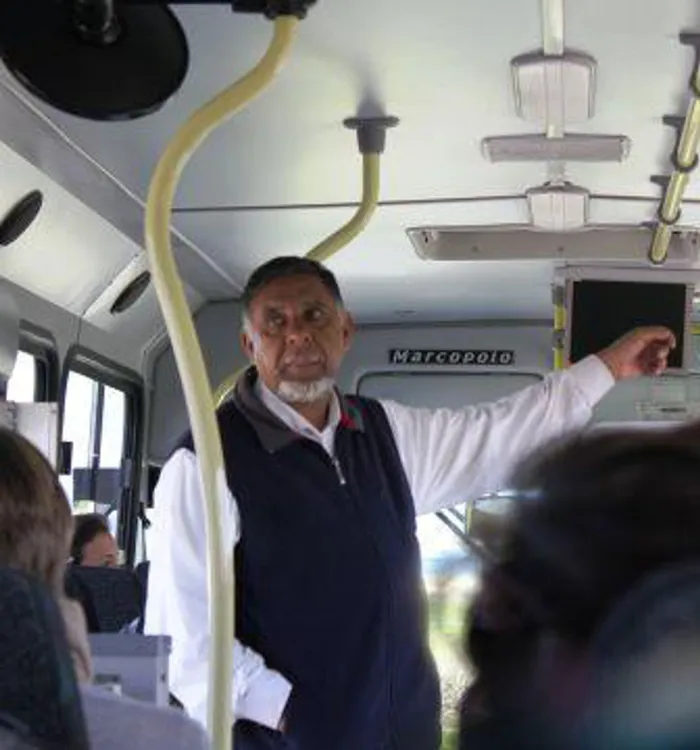
I felt like a tourist in my own city as we boarded the Sikhululekile ferry at the Clock Tower. Our group sat individually because the boat was full. On the island, we met our tour guide, Yasien Mohamed, on board a swanky BMW tour bus, a gift from Germany.
Speaking slowly and authoritatively, Yasien welcomed us to the island and asked where we were from. Hands sprung up for South Africa, the US, Japan, Nigeria, Britain, the Netherlands, Italy, Germany, India and Australia. The history of all these countries was interwoven with the story of the island, he told us.
Stopping at various sites, Yasien masterfully constructed a narrative about the island’s history – as a prison, a leper colony, a World War II military base – by including the nationalities represented on the bus. At a clump of eucalyptus trees (“thanks to the Australians”), Yasien explained the ecological challenges on the island. And so it went.
We stopped outside PAC leader Robert Sobukwe’s lonely house down from the main prison block. Yasien, who revealed here that he was an office-bearer for the PAC during the Struggle, described Sobukwe as the “forgotten hero of South Africa”.
Yasien is a veteran tour guide who has hosted luminaries such as Nelson Mandela, Helmut Kohl, Hillary Clinton, Bill Cosby and Barack Obama. Yet he narrated the story of the island as though he was giving it for the first time, with passion and vigour.
As we headed for the maximum-security building for a tour by an ex-political prisoner, Yasien shocked my US friends with a statistic that South Africa’s unemployment rate stood at 43 percent.
Generations of South Africans had been robbed of an education due to apartheid, he said. “Political prisoners don’t return here because they want to, but because it is work.”
At the prison gates, Yasien handed us into the care of Jama Mbatyothi. A product of the June 16 uprisings, Jama was still a teenager when he was jailed for five years on the island in 1977.
Jama described the prison structure: group cells of 30 prisoners; single cells; 4pm lock-up; different diets for “Coloureds/Asians” and “Bantus”; hard labour in the lime quarry; bucket toilets; censored letters; and monitored visits.
The pain of the Struggle years still evident, Jama asked politely whether we had questions before moving swiftly through his repertoire. He escorted us to the narrow corridor towards Madiba’s cell, the climax of the tour. “It’s the fourth on the right.”
We lined up. Silently, and in single file, we passed the cell that was Madiba’s home for 18 years. We lingered to take photos through the iron bars: the blanket, the bucket, the stool, the mug and plate, the cell window overlooking the prison yard.
Three and a half hours after first boarding the ferry, we were back on the mainland. Throughout the tour, there were no signs of an island in disarray.
Maybe we were lucky. Maybe the new chief executive, Sibongiseni Mkhize, is shaking things up. It was difficult to assess because although I have visited the island twice before on reporting assignments, this was my first experience as a tourist.
And as a Capetonian, it was a positive and memorable one. For my friends from Virginia, Tom Landon, Beth Macy and their 13-year-old son, Will, the pilgrimage to the island was a highlight of their trip.
“From the moment we got on the boat, it was a world-class interpretive experience,” said Tom, a social studies teacher and videographer. “Everything ran smoothly, the guides were excellent and the facilities well-kept.”
Will found Jama’s commentary the most compelling “because he had been a prisoner, he knew what he was talking about”.
Singling out Yasien, Beth, a reporter at the Roanoke Times, said: “I knew the scaffolding of the story, but didn’t expect the tour would make me feel so much. Yasien really made the story come alive… it felt honest. He made it human, funny and sad.”
South Africa, according to Yasien, was built on the legacy of three Struggle heroes with one message: “Reconciliation – to forgive and never take revenge.”
And so it should be that his three M-words – Mahatma Gandhi, Madiba and Martin Luther King – are symbolically rooted with the island, an isolated slab of rock that lays a universal foundation for the resilience and triumph of the human spirit.
l Heard is assistant editor, head of news, at the Cape Times