

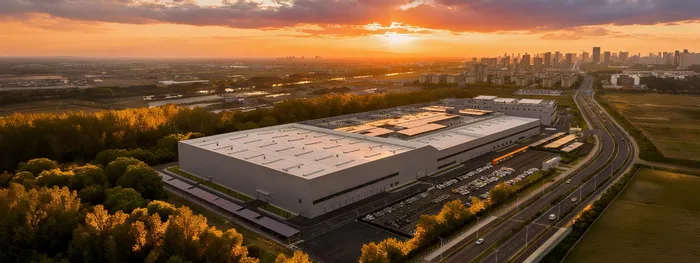
The Zeekr manufacturing plant spans roughly 300,000 square metres.
Image: Supplied
For years, Chinese automotive brands have battled perceptions around quality, safety and engineering credibility. But after visiting Zeekr’s advanced manufacturing and safety facilities in China, it became increasingly clear that the conversation has shifted dramatically.
As part of a recent media trip to China hosted by Geely Auto, we were given rare access to both the company’s state-of-the-art safety centre as well as the impressive Zeekr manufacturing facility.
The Zeekr manufacturing plant is staggering in scale. Spanning roughly 300,000 square metres, the facility operates with the precision and organisation of a high-tech laboratory rather than a traditional car factory.
The production lines are clean, heavily automated and remarkably quiet, with robotic systems carrying out much of the heavy assembly work with near surgical accuracy.
On the day of our visit, the facility was scheduled to produce around 300 vehicles, with the factory having an annual production capacity of 300,000 units.
At maximum operational output, running continuously over a 24-hour cycle, the plant is capable of producing as many as 1,200 vehicles per day. These outputs may likely be as and when demand for production ramps up.
What makes this even more impressive is the variety of products manufactured under one roof. The plant currently produces six different models, showcasing the flexibility and sophistication of the facility’s production systems.
Walking through the assembly areas, one gets the sense that this is not simply about manufacturing cars quickly. The emphasis appears heavily focused on consistency, precision, and quality control.
Every stage of the production process is monitored digitally, with extensive use of artificial intelligence, automated inspection systems, and connected manufacturing technologies.
For a brand like Zeekr, which positions itself as a premium electric mobility company, that attention to detail is crucial.
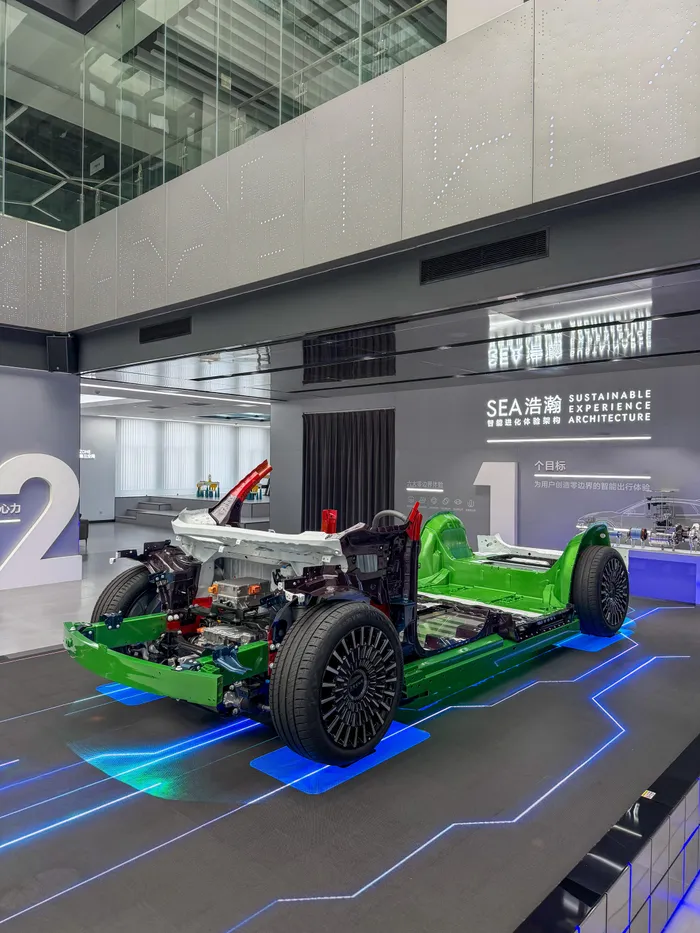
Every stage of the production process is monitored digitally, with extensive use of artificial intelligence, automated inspection systems, and connected manufacturing technologies.
Image: Supplied
Equally fascinating was the visit to Geely’s dedicated safety centre, where engineers conduct extensive crash simulations, vehicle safety development programmes, and even simulate various weather conditions such as heavy rain, snow and fog.
While many consumers still associate Chinese vehicles with affordability first, Geely’s investment in safety engineering suggests the company is equally focused on changing perceptions around occupant protection and vehicle integrity.
The facility conducts everything from high-speed crash testing to rollover simulations and battery impact evaluations for electric vehicles.
Engineers explained how virtual simulation technology now plays a major role in shortening development cycles, allowing thousands of digital crash scenarios to be analysed long before a physical prototype is destroyed.
This is particularly important in the EV era, where battery safety has become one of the most critical areas of vehicle development.
What stood out most during the visit was not necessarily the scale of the facilities, although both are undeniably impressive, but rather the confidence with which Geely and Zeekr now operate.
There is little sense of these brands merely trying to ‘catch up’ anymore. Instead, the focus appears firmly set on leading in areas such as electrification, software integration, battery technology and smart manufacturing.
As Chinese brands continue expanding locally, buyers are no longer simply purchasing budget alternatives. Increasingly, they are gaining access to vehicles backed by world-class manufacturing processes, advanced safety development and enormous investment into future mobility technologies.
After seeing firsthand what powers Geely and Zeekr behind the scenes, it becomes easier to understand why the global automotive landscape is changing so rapidly and why China’s role within it can no longer be viewed as secondary.