

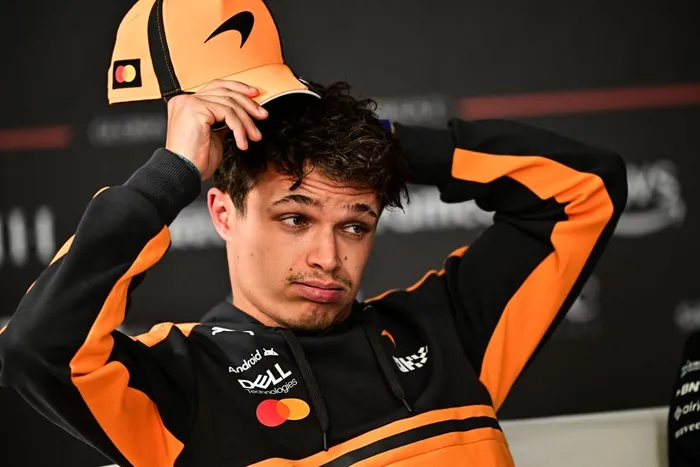
McLaren's British driver Lando Norris.
Image: AFP
Lando Norris has given the first sign that McLaren are not the dominating force they were last season. Under the new regulations, the dynamics of power at the top have been shuffled. Where the defending champions stand in the power dynamic is now yet to be seen.
But Norris has hinted they might not be at the top. Speaking after pre-season testing in Bahrain, the reigning world champion was measured in his assessment of the MCL40’s early form. While outright speed has flashed at times, Norris suggested the comfort McLaren enjoyed across race distances in 2025 is not yet present.
“We don’t have that luxury at the minute,” Norris admitted. “Last year, we could sometimes drive a bit slower and still be the quickest over a stint. That’s not the case right now.”
It is a subtle warning, but a telling one. McLaren’s title charge last season was built on supreme tyre management and a rear end that allowed both Norris and Oscar Piastri to lean on the car deep into a stint. Rivals often fell away as the race progressed, while the papaya machine only grew stronger. It's not a hundred per cent clear yet, but Norris' remarks suggest that edge is fading.
“The balance is not bad,” Norris continued, “but we have to push more to get the lap time. When you push more, you use the tyres more. That’s something we need to improve.”
Under the 2026 aerodynamic and power unit regulations, the cars demand a different driving style. Active aero and revised energy deployment systems have altered how teams approach both qualifying and race trim. McLaren’s previous sweet spot may not translate seamlessly into this new era.
And while McLaren search for answers, Ferrari have quietly turned heads. The SF-26 has looked composed and sharp through testing at the Bahrain International Circuit. On the long runs, it appeared stable through the high-speed sweeps, while its straight-line speed suggested efficient energy deployment. Most striking was the headline time set by Charles Leclerc, who topped the timesheets with the fastest lap of the test.
Leclerc’s benchmark run was not merely a glory lap. Ferrari’s consistency across multiple programs indicated a car that is both predictable and potentially quick over a full race distance. The body language within the Scuderia garage has also shifted. There is a sense that the Maranello outfit has arrived prepared for this new cycle.
For Norris, though, the full picture is a bit blurry at the moment. “It’s early days,” he cautioned. “We know where we need to find improvements. The potential is there, but we’re not the only ones who have done a good job.”
That final remark may be the most revealing. McLaren are still competitive. They are still in the conversation. But the aura of inevitability that surrounded them at the end of last season has faded. Testing form can deceive, and sometimes teams deceive on purpose to hide their true potential — like Max Verstappen calling out Mercedes for "sandbagging" their performance in testing.
Fuel loads vary. Engine modes are masked. Development curves differ. Yet in Formula One, tone matters. Champions rarely downplay their strength unless there is genuine uncertainty. Ferrari look sharp. Mercedes appear tidy. Red Bull remain an unknown quantity with their own innovations. The competitive order is no longer obvious.
McLaren may still unlock another level before the lights go out in Australia. But if Norris’s assessment is accurate, the papaya team begin this campaign not as hunted favourites, but as contenders in a reshuffled fight at the front.