

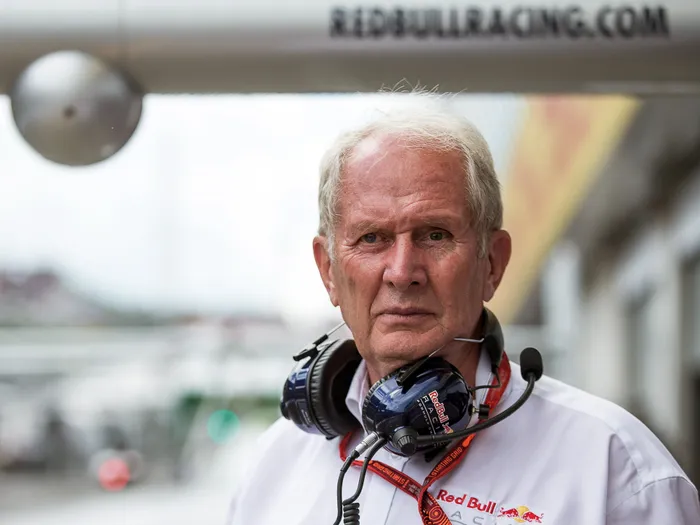
Long-time Red Bull advisor Helmut Marko will leave the organisation at the end of the season.
Image: FILE
Red Bull Racing has entered uncharted territory following the announcement that long-time advisor Helmut Marko will leave the organisation at the end of the season.
After more than two decades of serving as the team’s talent architect, enforcer and strategic voice, his departure is being described internally as the closing of an extraordinary era.
Red Bull’s upper management reacted with an unusual level of emotion. CEO Oliver Mintzlaff expressed “deep regret” at Marko’s decision to walk away, emphasising the Austrian's decisive role in all major strategic milestones that shaped Red Bull Racing into a modern Formula 1 powerhouse.
For a team that prides itself on controlled messaging and competitive focus, the tone of its statement was unusually heartfelt. Marko is not an ordinary executive, he is, in many ways, one of the main pillars of Red Bull's F1 identity.
For 20 years, Marko’s influence permeated every corner of the organisation. He shaped their junior program, oversaw talent scouting, approved high-stakes driver promotions and made the sort of brutal decisions that both elevated and ended careers.
His departure leaves what Red Bull themselves described as “a significant void”, particularly heading into 2026 and the next engine-regulation cycle. But this departure also opens another door for Red Bull, one Sebastian Vettel was rumoured to fill.
A major part of Marko’s legacy comes from the drivers he discovered, championed and advanced through the Red Bull system. At the top of that list is Max Verstappen, perhaps the most significant signing of his career.
Marko pushed aggressively to bring Verstappen into F1 at just 17, fast-tracking a generational talent who would go on to define Red Bull’s modern success.
He also played a crucial role in bringing Vettel into the program and overseeing his rise from Toro Rosso prodigy to four-time world champion.
Daniel Ricciardo, Carlos Sainz Jr., Pierre Gasly, Yuki Tsunoda, Daniil Kvyat, Jaime Alguersuari, Sébastien Buemi, Alex Albon and Brendon Hartley were all products of the system Marko helped build.
Many of the younger names in Formula 2 and Formula 3, including Liam Lawson, Isack Hadjar, Ayumu Iwasa and others, were signed under his guidance.
But Marko’s tenure was not without friction. His uncompromising style strained relationships with several drivers. Carlos Sainz Jr. never felt fully backed and clashed with Marko over perceived favouritism toward Verstappen.
Gasly endured intense pressure and public criticism during his short Red Bull stint, ultimately leading to an early demotion. Kvyat experienced multiple ups and downs, becoming one of the clearest examples of Marko’s ruthless decision-making.
Even Ricciardo, a trusted academy graduate, drifted away from Marko towards the end of 2018 after disagreements over his future. These relationships reflected Marko’s working philosophy: total performance above sentiment.
It made him one of the sport’s most influential talent spotters, but also one of its most polarising figures.
The most complicated and publicly scrutinised relationship, however, was his final major driver management chapter, Sergio Perez.
Checo joined Red Bull in 2021 and initially enjoyed strong support. Marko praised his experience and tyre management and believed he was the right fit to stabilise the team around Verstappen.
But tensions began to surface during Perez’s form slump in 2023. Marko criticised the Mexican driver’s inconsistency, but crossed a line when he attributed Perez’s difficulties to his “South American” background, incorrect and widely considered offensive.
The backlash was immediate. Marko apologised publicly, Perez accepted the apology, and the two attempted to move forward professionally. Yet the damage lingered beneath the surface.
Perez’s performances fluctuated, and pressure within the team increased. By late 2024, with results declining and Verstappen needing stronger support, the partnership fractured. Red Bull and Perez parted ways, and Marko later admitted he no longer believed a revival in form was possible within that environment.
As Marko prepares to leave, Red Bull face an identity shift. The team must now redefine its driver philosophy without the man who built it. Whether this ushers in a gentler era or exposes gaps in leadership remains to be seen, the departure of Marko signifies a watershed moment in Red Bull’s short but decorated F1 history.