

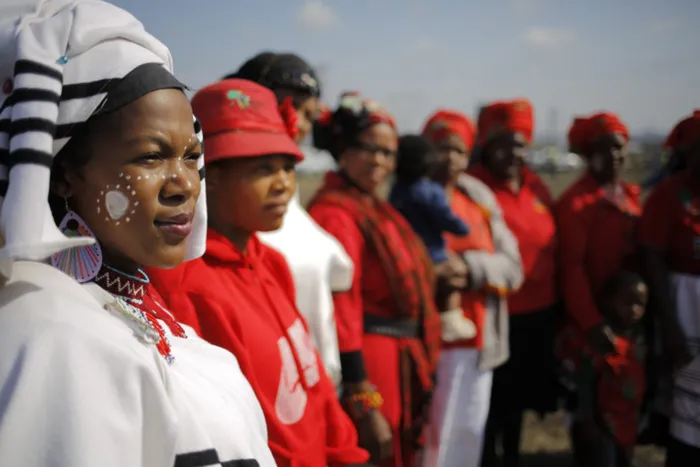
Women gather at the 4th anniversary of the Marikana shooting in Rustenburg on Tuesday. Relatives and fellow miners gather at Wonderkop hill each year to remember those who died and were wounded. Women gather at the 4th anniversary of the Marikana shooting in Rustenburg on Tuesday. Relatives and fellow miners gather at Wonderkop hill each year to remember those who died and were wounded.
Rustenburg - “Why did the company not compensate us, why did they not care that we lost everything? We have nothing now.”
These questions were common among widows of the 34 striking Lonmin miners who were gunned down by police during the Marikana massacre in 2012.
An emotional Nosakhe Nokhamba, who was addressing a commemoration on Tuesday, accused the platinum mining giant of continuing to fail the North West community, but more importantly, it had failed the families of the dead miners who were “suffering’’ due to the loss of their breadwinners.
Nokhamba left many in the crowd teary-eyed after speaking about how her children’s school books were torn up for being “tattered and dirty”.
“My child’s book was torn up by his teacher after the teacher told him his book was so dirty. My child knows what happened to his father. He told the teacher we struggle at home and we don’t even have enough to eat.
"The teacher must ask Lonmin mine why the book looks like that; they killed his father.”
Thousands of people, including opposition politicians, religious leaders and widows attended the commemoration which was hosted by mining union, Amcu.
Widows sat in a tent where they shared stories of the massacre and what had become of their lives. Nandipha Guluza said she has two children and every day was a struggle to get food on the table.
“My last born was just nine days old when my husband was killed. My other son was 5 years old when the killings happened and he knows exactly what happened to his father.”
Guluza said she knew that one day her children would demand details of that tragic day, but for now her main concern was providing for them.
“I remember it and it hurts me,” she said.
She said the situation was made worse because the government had done very little for the community.
Despite the mining company undertaking to uplift the community – it is expected to do so according to the Mining Charter – residents believe Lonmin and the government have done far from enough. Extreme poverty is prevalent, and there are no basic services such as electricity and running water.
Also despite getting the R12 5000 increase that striking miners demanded in 2012, in reality miners believe they are poorer due to soaring living costs, poor housing and no service delivery.
Miner Johannes Mafohla, who watched proceedings from the koppie, told Independent Media that he was so disgusted that the company would not pay for the day because he had to take leave to attend the commemoration.
“No work, no pay. They do not think about us. It is a disgrace,” he said.
@heidigiokos